J10 Interview: Antisemitism and Holocaust memory The German foundation Remembrance, Responsibility and Future (EVZ) marks, this month, 25 years since the beginning of compensation payments to the last survivors forced to work under the Nazi regime. But some argue that these payments should have started much earlier, right after the end of World War II in 1945, and that they should also have been significantly larger. According to EVZ, €4.4 billion (about R$ 23.6 billion) was paid to 1.66 million former forced laborers and their legal successors in about a hundred countries between 2001 and 2007, when the final indemnities were concluded. It is estimated that about 26 million people were forced to work for the Nazi regime between 1933 and 1945, approximately half of them in occupied territories outside Germany's borders during World War II. Historical studies indicate that if all the labor exploited during the Nazi era had been fully compensated, the original fund would have had to total between 90 billion and 112 billion euros (about R$ 483 billion and R$ 601 billion). "If you ask me: was it a large fund? No, of course not, considering the injustice," said EVZ director Andrea Despot. "There were about 26 million people working in factories, in agriculture, in churches, in private residences, and in companies.
Almost no sector of society failed to benefit from this. One can say that the fund did not come close to compensating for the damage and exploitation suffered." EVZ was created in July 2000, both to compensate forced laborers and to promote and finance projects aimed at defending human rights, democratic values, and the interests of Nazi regime survivors. The organization was established with a fund of 10.1 billion German marks, equivalent to about €5.16 billion (R$ 27.7 billion), with half coming from the federal government and the other half from an initiative that brought together about 6,500 German companies — called the German Industry Foundation Initiative.
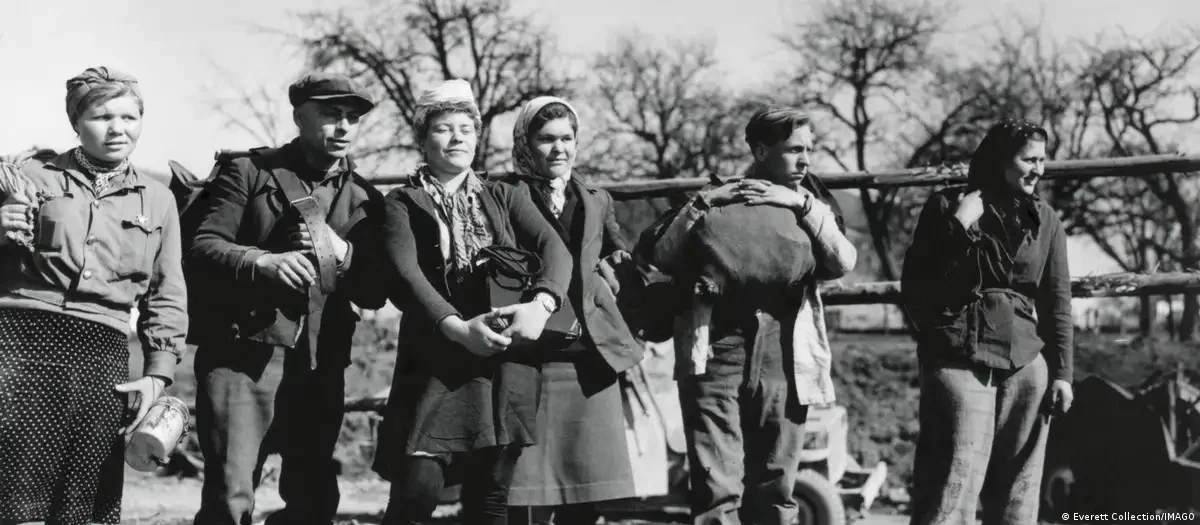
Many of these companies, though not all, had used forced labor. Group of Russian civilians forced to perform forced labor during the Nazi regime Photo: Everett Collection/IMAGO 'Symbolic' compensations Although West Germany adopted reparation measures, such as the Federal Compensation Act of 1953 aimed at people persecuted for political, racial, or religious reasons, these initiatives excluded forced laborers. Between the 1950s and 1980s, under public pressure, some large West German companies voluntarily paid millions of German marks in compensation, but these payments did not reach people from Eastern Europe. The debate in the 1990s was difficult, with many German companies initially refusing to contribute to the fund and take responsibility for the use of forced labor. "In the end, it was basically a symbolic solution," says historian Constantin Goschler from Ruhr University Bochum, who published a comprehensive collection of studies on the subject in 2012. "The people representing the claimants advocated for an amount of at least double digits [in billions], while those who would pay wanted an amount that did not exceed double digits," he recalls.
"Thus, they reached 10 billion German marks. This did not reflect the scale of the damage; it was the result of psychological negotiation."
Class action lawsuits, especially by Jewish groups Legal pressure also played an important role as different groups of victims — especially in the United States — increasingly turned to class action lawsuits. "It wasn't a purely moral or ethical decision. That carried weight, but it wasn't the only factor," says Despot. "After decades of demands from survivors, there was international pressure, especially from the United States and Jewish organizations, which were preparing class action lawsuits." These threats ultimately led Germany to negotiate with the United States in order to guarantee legal certainty in the future. Why did the compensation take so long? According to Goschler, there is one central reason why the German state took more than half a century to offer compensation to former forced laborers: the Cold War.
"There was a principle: money was not sent to the other side of the Iron Curtain." This meant that West Germany refused to transfer funds to Eastern countries, especially Poland. Another factor, according to the historian, is that former forced laborers in Eastern Europe were often treated with suspicion and therefore received little support in their own countries. "Forced laborers — many of them women — in the former Soviet Union were viewed as collaborators for having worked for the Nazi war economy. Upon returning, they were met with distrust, sent to screening camps, and led very difficult lives," he explains. When Germany finally began making payments, many survivors were less interested in the money than in historical recognition.
"More important than the amount received was the certificate confirming that they were victims, not traitors." Defense of human rights and democracy There are still many former forced laborers alive. The Jewish Claims Conference estimates that there are about 200,000 Jewish survivors worldwide, along with several hundred thousand Eastern Europeans, Sinti and Roma, and former political prisoners who were forced to work by the Nazis.
Exact numbers for these groups have never been established. Although indemnities were paid years ago, EVZ's work continues. Today, the foundation acts as a charitable entity, funding projects aimed at promoting human rights, democratic values, and historical and political education. According to Despot, EVZ's main goal today is to preserve Germany's historical memory of the Nazi period, especially the forced labor system that benefited thousands of German companies. In 2025, EVZ was classified as an "undesirable organization" by the Kremlin after expressing support for Ukraine. "Ukraine, Belarus, and Russia were deeply scarred by the German occupation, which was genocidal and exploitative," says Despot.
"These countries have always been partners in our work. Russia's war against Ukraine also represents an attack on Ukrainian identity and history." Currently, EVZ supports Russian and Belarusian organizations that have been forced into exile by their governments.




Sign in to comment on this article.
No approved comments yet.