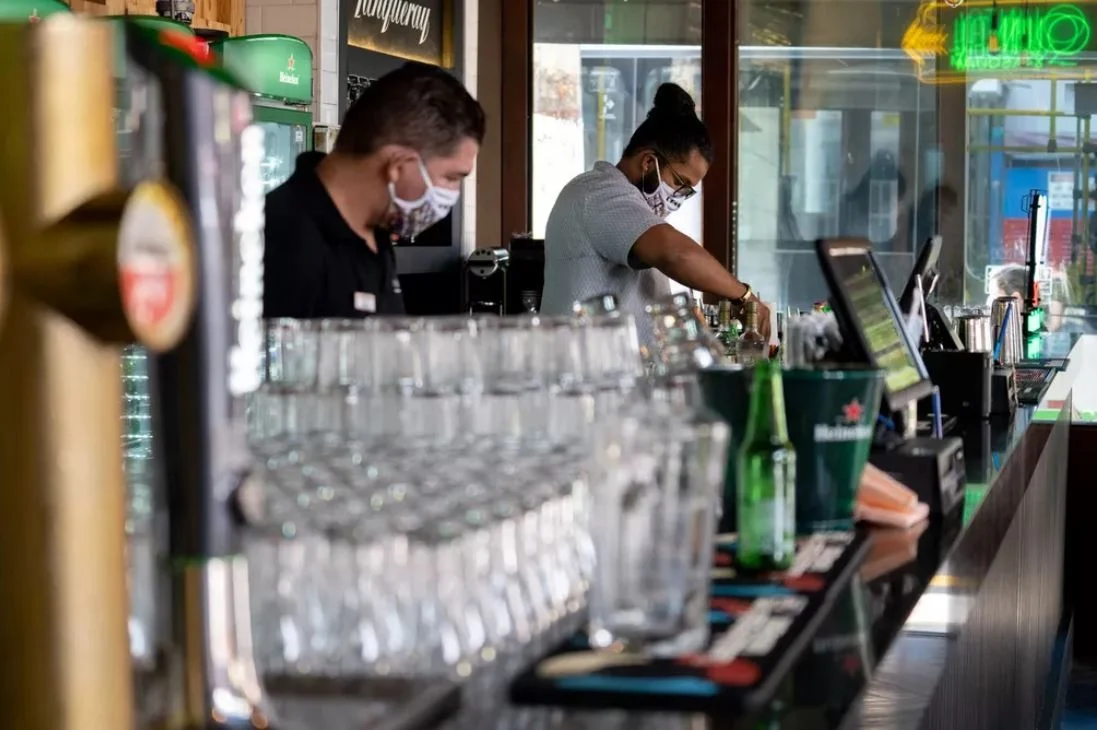
Bar employees in Vila Madalena. Marcelo Brandt/G1 The Brazilian economy is experiencing a phenomenon that defies economic forecasts. The benchmark interest rate began to fall after reaching its highest level in 20 years, while the population faced record levels of debt and delinquency. Economists expected a slowdown in economic activity as early as the first quarter of 2026.
The Gross Domestic Product (GDP), however, showed an increase in household consumption in the period: a 1% rise compared to the previous quarter and 1.7% against the same period last year. 🗒️Do you have a story suggestion? Send it to g1 According to experts, the heated labor market and the increase in household income — both through employment and public income transfer policies — help explain this scenario. The unemployment rate in the quarter ending in April was 5.8%, the lowest level for the period in the historical series of the Brazilian Institute of Geography and Statistics (IBGE). In the same period, the usual real income of workers was R$ 3,732, a value 5.3% higher than a year earlier. Now on g1 Are you among the richest in Brazil? See how much you need to earn to enter the top income bracket “People need to remain inserted in the labor market to keep up with consumption.
This makes the market react to adverse effects, such as the interest rate, with a certain sustainability,” said Adriana Beringuy, coordinator of household surveys at the IBGE. Along with the strong labor market, the real increase in the minimum wage, the expansion of the Income Tax exemption bracket for those earning up to R$ 5,000, and the debt relief promoted by Desenrola 2.0 were some public policies that maintained the population's income gains. “We have had, over the years, a series of income transfers. This money goes directly to immediate consumption, such as food, clothing, and services,” says André Sacconato, economic advisor to the Federation of Trade in Goods, Services and Tourism of the State of São Paulo (FecomercioSP). According to experts, this consumption profile also reflects the growing digitalization of the economy.
Part of the progress in the service sector is linked to areas such as technology, internet, and telephony. According to Juliana Trece, coordinator of the national accounts center at the Brazilian Institute of Economics (Ibre), of the Getulio Vargas Foundation (FGV), other segments that boost consumption are bars, restaurants, and travel. “The curious thing is that, even with high interest rates, durable goods — which normally grow less in this scenario — continue to advance, with a highlight on the increase in the consumption of imported automobiles, especially hybrids and electric ones. As for non-durable goods, there is higher consumption of essential items,” she says. Rising consumption hits the wall of rising debt Even though the economy is sending positive signals, experts warn about the level of household debt.
The most recent data from the Central Bank (BC) show that the indicator reached 49.8% in March, an increase of 0.8 percentage points compared to the same month in 2025. “The middle class is pressured because it has higher consumption sustained by credit, which is becoming increasingly expensive,” says Sacconato, from FecomercioSP. The BC survey also shows a significant increase in delinquency in almost all types of credit for individuals. In lines with free resources — those where rates and conditions are defined by banks — defaults reached 7.2%. 🔎 Delinquency is especially serious because it represents the percentage of credit operations with delays exceeding 90 days in relation to the total balance.
The most recent result shows an increase of 1.2 percentage points compared to April 2025 (6%). “The middle class cannot consume today as it did years ago. The current economic model, based on income transfers, is not sustainable because, in the end, it increases debt, delinquency, and the need to keep interest rates high for longer,” says Sacconato. Record income and low unemployment: why does the Brazilian remain in debt, even earning more? Should consumption continue to rise? Even with the prospect of high interest rates and inflation in the coming months, experts assess that household consumption should continue to grow this year. According to Juliana Trece, the FGV Ibre projection is that household consumption will end the year with a 2.2% increase, above the 1.3% growth recorded last year. “We know that the Central Bank should be increasingly cautious in interest rate cuts.
The heated labor market should still contribute and, as it is an election year, it is possible that there will be new stimuli through income transfer programs,” says the economist.




Sign in to comment on this article.
No approved comments yet.