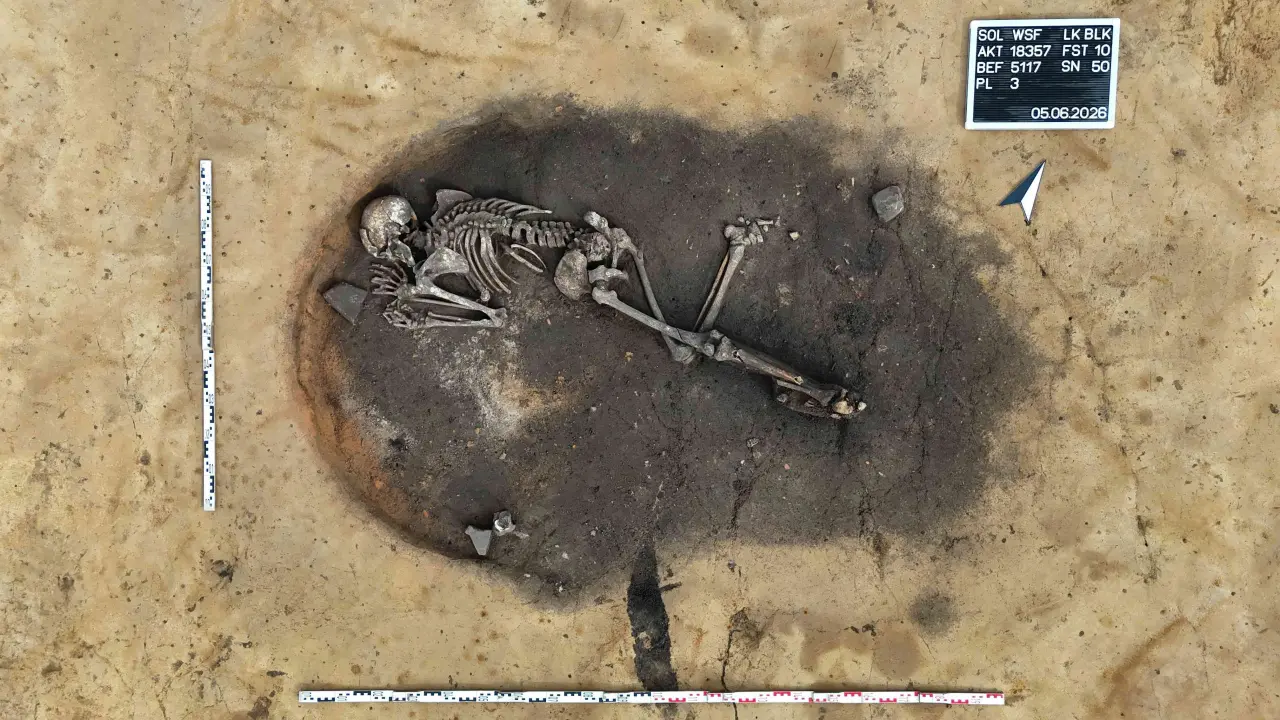
A dead man found in an underground oven. Mysterious archaeological discovery near Gerstewitz, Burgenland district, Saxony-Anhalt. State Office for Heritage Management and Archaeology Saxony-Anhalt Archaeologists conducting excavations in eastern Germany have found the remains of a man about 25 years old buried in an ancient structure used as an oven approximately 4,500 years ago. The find intrigues researchers because the skull shows signs of injury and the burial site is considered unusual for the time. The discovery was made near the town of Gerstewitz, in the state of Saxony-Anhalt, during preventive excavations carried out before the construction of an electrical transmission line. According to the State Office for Heritage Management and Archaeology of Saxony-Anhalt, the man was buried in an underground cavity formed by two interconnected chambers, originally used as an oven by the so-called Corded Ware Culture, which occupied parts of Europe between 2900 B.C.
and 2050 B.C. Now on g1 Skull injury raises hypotheses The skeleton was found in a fetal position, lying on its right side and facing south — a typical characteristic of male burials of this cultural group. What caught the researchers' attention, however, was the location chosen for the burial. Structures of this type do not normally contain human remains. Furthermore, initial examinations identified an injury to the skull. Given this, archaeologists are working with different hypotheses.
One of them is that the young man was a victim of murder. Another possibility is that he died in a conflict and was buried in a hurry in an existing structure. There is also a third line of investigation: that the burial was related to some ritual. Ritual sacrifice? According to the researchers, similar ovens linked to the Corded Ware Culture have already been found containing complete cattle skeletons or partially dismembered dog remains. These deposits are interpreted by some experts as possible ritual offerings. Therefore, scientists do not rule out that the man found in Gerstewitz also participated in some ceremonial context, although there is not yet enough evidence to confirm this hypothesis. Region holds 6,000 years of history The archaeological site where the body was found has revealed traces of human occupation that span about 6,000 years. Among the previous discoveries are a large burial mound built between 4000 B.C. and 3400 B.C., systems of ditches and walls associated with collective ceremonies, and remains of burned houses, in addition to human and animal bones deposited in deep pits. Now, researchers hope that laboratory analyses will help clarify the man's identity and the circumstances of his death. For now, the find remains surrounded by mystery — a rare case in which a prehistoric burial raises more questions than answers.






Sign in to comment on this article.
No approved comments yet.