New animal species discovered in Paraná in a fossil older than dinosaurs A new animal species was discovered in Ponta Grossa, in the Campos Gerais region of Paraná, after the analysis of a 400-million-year-old fossil – meaning it is older than dinosaurs, which emerged less than 250 million years ago. It is a marine mollusk of the genus Actinopteria. It has been named Actinopteria grahni, in honor of a Swedish professor who lived in Brazil and contributed to the study of fossils in the city's region.
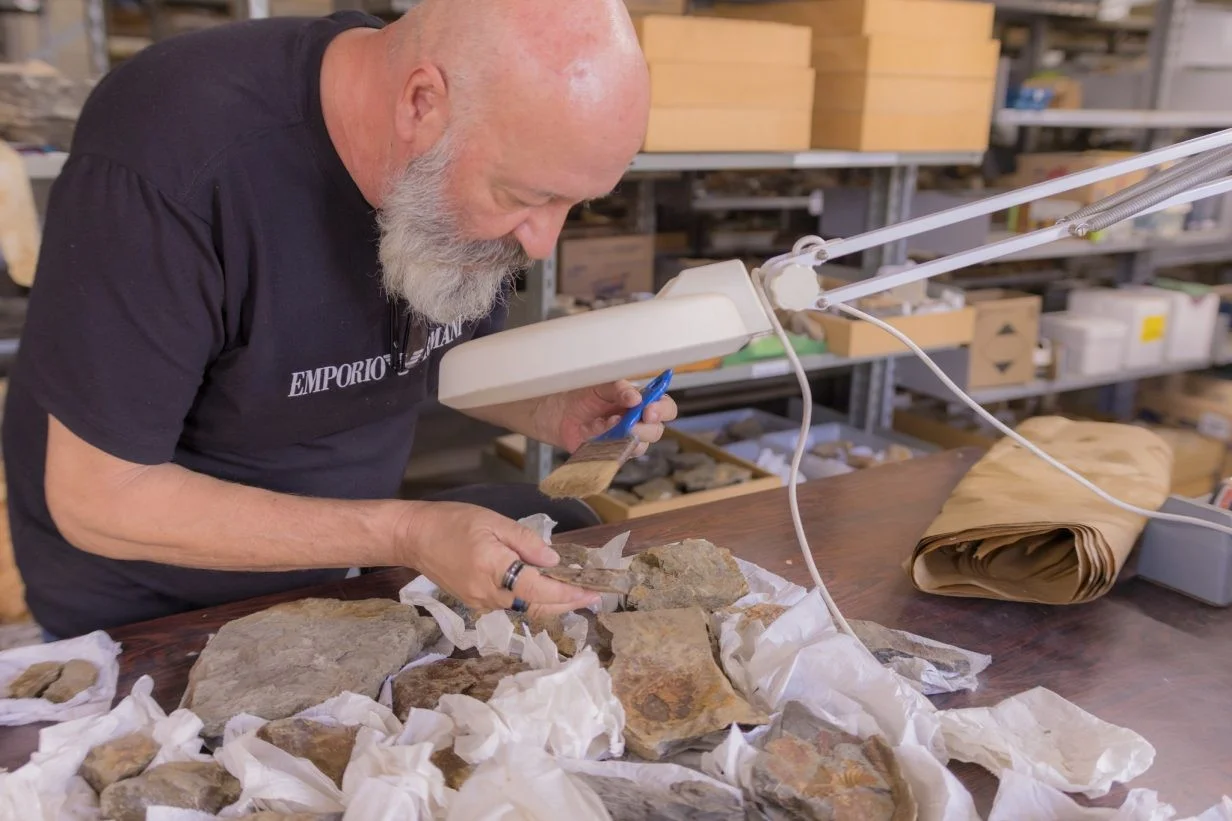
Learn more below. ✅ Follow g1 Ponta Grossa on WhatsApp The discovery was made by professor Elvio Pinto Bosetti and geography PhD student Kevin William Richter, from the State University of Ponta Grossa (UEPG), and published in Historical Biology, a UK scientific journal of paleobiology. New mollusk species discovered in Paraná in a fossil older than dinosaurs André Packer/UEPG The fossil that allowed the identification of the new species was found at a paleontological site located in Jardim Giana, known as Curva 2 – a fossil-rich outcrop known since the 1980s. The researchers explain that specimens of Actinopteria langei – a mollusk of the same genus and very similar to the new species – had already been found in this region of Ponta Grossa. Initially, the proposal was to find more specimens of this mollusk.
"Kevin decided that he would write a paper with these creatures. He said: I'm going back to the field where you found them and I'm going to look for more.
He found about 20 more. Among these 20, there appeared a species that the National Museum specialist said: look, this is a new species.
[...] Finding a species is luck, right? We more or less know where to look, but finding a rare creature is luck," states Professor Elvio. The professor adds that most fossils are the result of catastrophes, and that the Ponta Grossa region was once a sea floor and part of the Paraná basin.
It covered 1.6 million square kilometers, from Argentina to Tocantins - and, in Ponta Grossa, the layers remained preserved. "You have the Devonian period, 400 million years ago, which is of a sea marked by storms.
It is these storms that fossilize, kill life, and leave the record," explains Professor Elvio. New mollusk species discovered in Paraná in a fossil older than dinosaurs UEPG The first records of Actinopteria species in the region were made in the 1960s by paleontologist Setembrino Petri.
With the new discovery, the number of known specimens increases and, according to the researchers, allows for a better understanding of the fauna and dispersion patterns among sedimentary basins. "From a paleoecological point of view, the study made it possible to interpret that these species lived in shallow marine environments and were partially buried in the substrate, presenting adaptations related to these paleoenvironments," explains Kevin. With the advancement of the research, Elvio and Kevin decided to reinforce the team. Professor Sandro Scheffer, from the National Museum of Rio de Janeiro, specialized in taxonomy and classification, joined the work.
Meanwhile, Professor Renato Ghilardi and his postdoctoral student Victor Rodrigues Ribeiro, both from São Paulo State University (Unesp) in Bauru, also contributed to the paleography and species distribution in South America. The fossil will soon become part of the collection of the Museum of Natural Sciences (MCN) of UEPG. New mollusk species discovered in Paraná in a fossil older than dinosaurs UEPG Read also: Recall: Asphalt paving work halted on a Paraná highway due to fossils of animals older than dinosaurs See images: Over 2.6 thousand fossils older than dinosaurs are discovered during high-voltage tower construction works UFOs in Paraná? Recall other cases that raised suspicions of ET visits in the state Researchers' work New mollusk species discovered in Paraná in a fossil older than dinosaurs André Packer/UEPG Researchers explain that it was possible to detect that it was a new species based on the analysis and comparison between the images of the species Actinopteria langei and Actinopteria grahni. The outline of the shell, the morphology of the anterior auricle, the posterior expansion, and the radial ornamentation were some of the examined points where it was noticed that it was an animal that had never been cataloged before. "The well-developed lobular auricle, although occupying a small area of the anterior margin, distinguishes this species from all other Brazilian species, particularly Actinopteria lancei, in which the auricle is very small," explains a excerpt from the article. New mollusk species discovered in Paraná in a fossil older than dinosaurs André Packer/UEPG According to Professor Elvio, the next stage of the research is to find more shells of Actinopteria grahni. "We are going to return to this location to find more species like this.
The idea is that museums and people who work with this, who had materials like this, reassess what they had and believed to be another species. After all, science is a constant reassessment," the professor explains.
Another perspective is the interest that the discovery may generate for the productive sector, since organic material (remains of algae, plants, and animals) is the basis for the formation of natural gas – widely used in homes, businesses, industries, vehicles, and in electricity generation. "The more I know about these ancient seas, the greater the potential to find natural gas.
I lower the cost of production, because where there is organic material, it is an indication of where there might be oil or gas," he explains. Tribute to deceased professor Carl Yngve Grahn died in 2025 Reproduction/Brazilian Paleontological Society The name of the species honored Swedish professor Carl Yngve Grahn, who passed away in 2025, for his contributions to the biostratigraphy of Brazil – especially in the Devonian Escarpment in Paraná. "He helped us a lot in the lab and worked with us for 20 years.
Basically, he was the one who put us on the international scene and we decided to pay this tribute," explains Professor Elvio. He reinforces that Grahn visited UEPG several times, passed away at age 80 while living in Spain, and lived in Brazil for a long time. "He was a Swede who couldn't stand the cold anymore," the professor jokes. According to the Brazilian Paleontological Society, Dr.
Grahn graduated in Geology from Lund University (1976), earned his doctorate from Uppsala University (1982), and obtained his Habilitation (Livre-Docência) from Stockholm University (1993). His academic and professional career included stints at institutions such as Ohio State University (USA), the Geological Survey of Sweden, the Swedish Museum of Natural History, the University of Rennes (France), and in Brazil, where he acted as a researcher and visiting professor at the State University of Rio de Janeiro (UERJ), as a long-time consultant for Petrobras, and in the Palaios Group of the State University of Ponta Grossa (UEPG). His expertise focused on the area of Stratigraphic Paleontology, with an emphasis on the study of chitinozoans, microfossils of great importance for the dating and correlation of Paleozoic rocks.
Dr. Grahn was a pioneer in refining the biostratigraphic zonation of Brazilian sedimentary basins (Solimões, Amazonas, Parnaíba, Paraná, and Chaco-Paraná), establishing regional and international correlation standards that remain a reference to this day. "His work was crucial for dating Silurian and Devonian sequences, characterizing glacial events in Gondwana, and understanding the paleogeographic evolution of South America.
His unique productivity is reflected in scientific articles, book chapters, technical reports, and the mentorship of new generations of paleontologists. Dr.
Grahn was a tireless researcher, with a brilliant and generous mind, always willing to collaborate and share knowledge. [...] In addition to his immense scientific contribution, he was known for his kind character, his incessant intellectual curiosity, and his deep love for science". Most watched videos from g1 Paraná: See more news from the region on g1 Campos Gerais and Sul.





Sign in to comment on this article.
No approved comments yet.