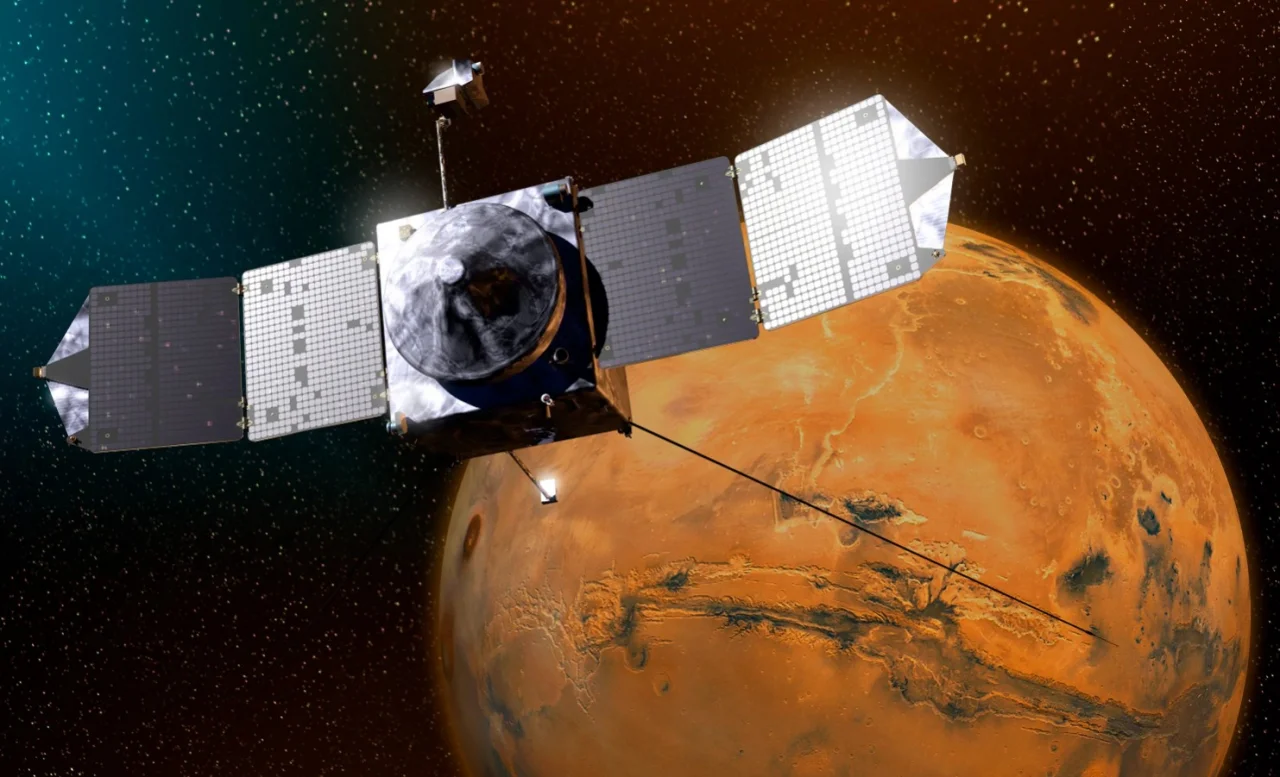
Artistic conception of NASA's MAVEN probe on Mars. The spacecraft entered orbit around the planet in 2014 and spent more than 11 years observing the Martian upper atmosphere, the ionosphere, and the interactions with the Sun and solar wind to investigate how the red planet's atmosphere is being lost to space. Disclosure/NASA NASA announced this Wednesday (3) the end of the mission of the MAVEN (Mars Atmosphere and Volatile Evolution) probe, which had been studying the atmosphere of Mars since 2014.
The decision was made after the agency concluded that the spacecraft can no longer be recovered. The last contact with MAVEN occurred on December 6, 2025. At that time, the probe passed behind Mars in relation to Earth and stopped transmitting signals.
Since then, NASA teams had been trying to re-establish communication. An investigation by the agency indicated that the spacecraft entered safe mode and began spinning at an abnormal speed. As a result, the batteries were depleted, the communication system lost power, and the probe became unable to send data. According to NASA, it is not yet possible to determine the original cause of the failure.
A final report on the incident is expected to be released later this year. Now on g1 More than a decade on Mars Launched in November 2013, MAVEN arrived in Mars orbit in September 2014. The mission was expected to last only one year, but remained active for more than 11 years. Its main objective was to investigate how the red planet lost much of its atmosphere over billions of years.
The findings helped explain why Mars, which may have harbored liquid water in the past, became a cold and arid world. Among the most important results of the mission are: the demonstration that solar storms accelerate the loss of the Martian atmosphere; the discovery of new types of auroras on Mars; the direct observation of the process by which particles escape the atmosphere into space; studies on the impact of global dust storms on the planet's water loss. In addition to scientific research, MAVEN also functioned as a kind of relay for data sent by exploration robots on the surface of Mars. Legacy for future missions According to NASA, the data collected by the probe will continue to be used by scientists for decades and will be important for planning future manned missions to the planet. "The science produced by MAVEN is fundamental to understanding what radiation protection and safety measures will be necessary before sending humans to Mars," said Louise Prockter, director of NASA's Planetary Science Division. The mission generated more than 800 scientific studies throughout its operation.




Sign in to comment on this article.
No approved comments yet.