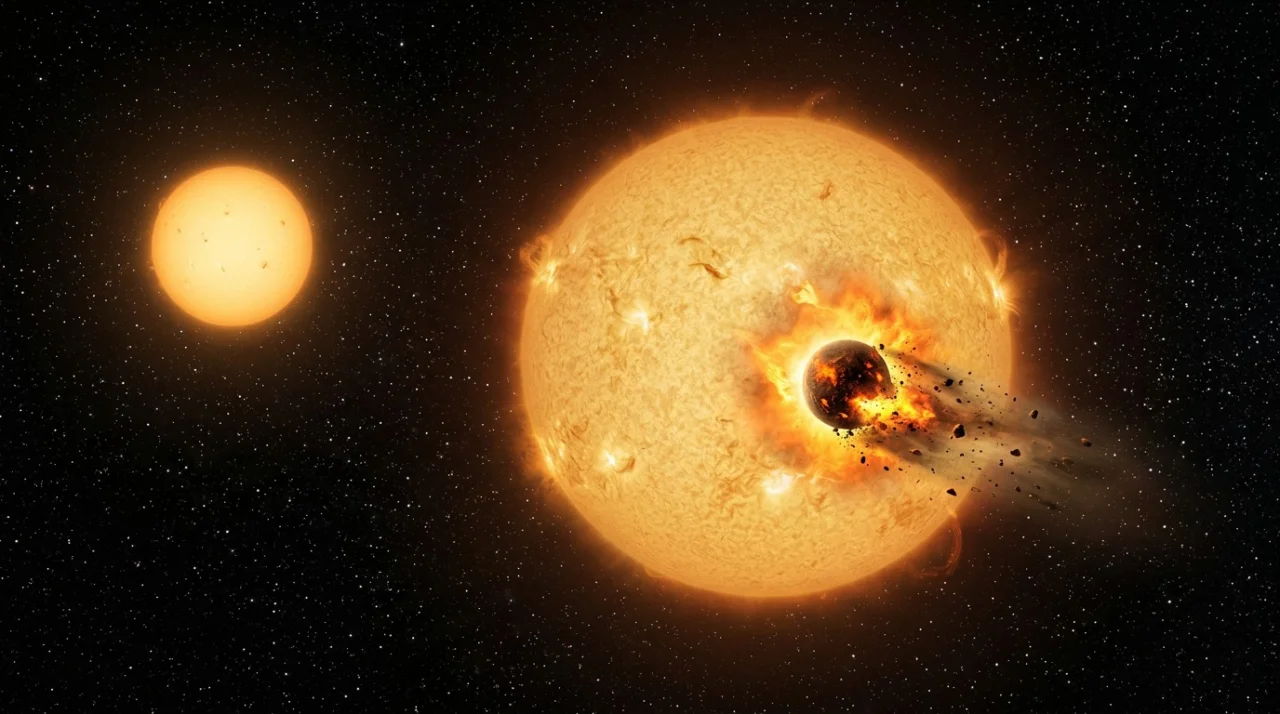
Illustration of a binary system in which a star swallows a planet. Anne Rathsam/Adobe Firefly Two "twin" stars, born at the same time and from the same cloud of gas and dust, should have exactly the same chemical composition. But that is not what astronomers have observed in some binary systems — pairs of stars that orbit each other.
In some cases, one of the stars appears more "enriched" in certain elements than its twin, and scientists did not yet know exactly why. A new study, led by astronomers from the Institute of Astronomy, Geophysics and Atmospheric Sciences of the University of São Paulo (IAG/USP), in partnership with scientists from Poland, Italy, China, and Australia, found an explanation for this mystery. And, as a bonus, a new tool to identify stars that, in the past, may have devoured one of their own planets. The study, published in the journal "Astronomy & Astrophysics", analyzed the pair of stars HD 129171 and HD 129209 and discovered that one of them has a greater amount of certain chemical elements than the other.
For scientists, this difference is the "mark" left by a rocky planet that was swallowed. Trending videos on g1 In an interview with g1, astronomer Anne Rathsam, a doctoral student at IAG/USP and lead author of the study, explained the step-by-step of the discovery and what it represents. According to Rathsam, to understand what happened to these stars, one must first look at their chemical composition. "What 'gives away' that the star swallowed a planet is its chemical composition," explained the researcher.
"When the star ingests one of its planets, this material is mixed into its surface." The astronomer highlights that there are two large groups of chemical elements: volatiles, which usually exist in gas form, and refractories, which normally form solids — and which are precisely the main ingredients of rocky planets, like Earth, and the cores of giant planets, like Jupiter. It was exactly this second group that caught the researchers' attention. When comparing the two stars of the pair, they noticed something curious: the more "refractory" the analyzed element was, the greater the difference between the two stars.
The star HD 129171 proved to be consistently richer in these materials than its twin, HD 129209 — a pattern that, according to scientists, only makes sense if it had "absorbed" extra rock at some point in its history. Within this group of refractory elements, two of them stole the show in the research: lithium and, especially, beryllium. The explanation lies in how these elements behave inside a star.
Neither of them is produced in the stellar interior — that is, any unexpected "leftover" of these elements can only have come from outside, from the ingestion of rocky material. At the same time, both are slowly destroyed by the extreme heat of the star's core as time passes. Image of the twin stars HD 129171 and HD 129209. Digital Sky Survey via Aladin/Anne Rathsam The difference is that lithium is destroyed at lower temperatures — about 2.5 million degrees Celsius — while beryllium resists up to about 3.5 million degrees.
To get an idea, even the Sun, with its "mild" surface of 5,800°C, has a core that reaches 15 million degrees. This means that when a star swallows a planet, it gains a temporary "excess" of lithium and beryllium — but, over time, this signal fades. Since beryllium withstands higher temperatures before being destroyed, its mark lasts longer than that of lithium.
For this reason, according to the researcher, previous studies on possible cases of "planet-eating stars" had left beryllium aside, precisely because of the technical difficulty of measuring it — a gap that this research helped to fill. Since beryllium is destroyed at higher temperatures, it is more resistant, and its signature can last longer than the lithium signature. Thus, beryllium can be a stronger indicator of planetary ingestion than lithium. NASA investigates anomaly in Earth's magnetic field, which could cause chaos in communications To reach these conclusions, the team used data from the UVES spectrograph, installed on the 8.2-meter VLT (Very Large Telescope) at the European Southern Observatory in Chile.
This instrument works like a sophisticated prism, separating the light of the stars into different frequencies and revealing the presence of each chemical element. The analysis showed that HD 129171 and HD 129209 have similar compositions when it comes to volatile elements — as expected for two "twin" stars. However, when the focus shifts to refractory elements, HD 129171 stands out as the more "enriched" of the two, with higher abundances of lithium and beryllium as well.
"Since HD 129171 is much richer in refractory elements than HD 129209 (and the more refractory the element, the greater the difference), and in particular, has a higher abundance of lithium and beryllium, we have strong evidence indicating that HD 129171 ingested a planet," explains Rathsam. Illustration of the Solar System European Space Agency/Silicon Worlds And can we know what type of planet was swallowed or when it happened? According to Rathsam, only partially. The chemical signature shows that there was ingestion of rocky material, but it does not reveal whether it came from a single large planet or several smaller bodies — in stars with a mass similar to the Sun, like those in the study, all the added material mixes and disappears quickly, making the two scenarios indistinguishable. As for the "when," there is a clue: since the extra lithium and beryllium have not yet been totally destroyed, the event must have been relatively recent on the astronomical scale, although an exact date depends on theoretical models that are still not very precise.
The most intriguing point, however, lies in the implications for the search for life outside Earth. Pairs of "twin" stars with different chemistry intrigued astronomers: either the clouds that form the stars are not as homogeneous as previously thought, or some of the stars swallow their own planets at some point. The discovery of the HD 129171/HD 129209 pair, with the new beryllium "tool," reinforces the second hypothesis — very different from the Solar System, which has "eight planets with almost circular and very stable orbits," as Rathsam highlighted. If unstable systems are common in the universe, systems like the Solar one may be rarer than imagined. And this matters because complex life requires thousands of years to emerge and evolve — something that only happens on a planet that is not destroyed by its own star along the way. VIDEO: Does pollution really make the sky more beautiful? Does pollution really make the sky more beautiful?.






Sign in to comment on this article.
No approved comments yet.