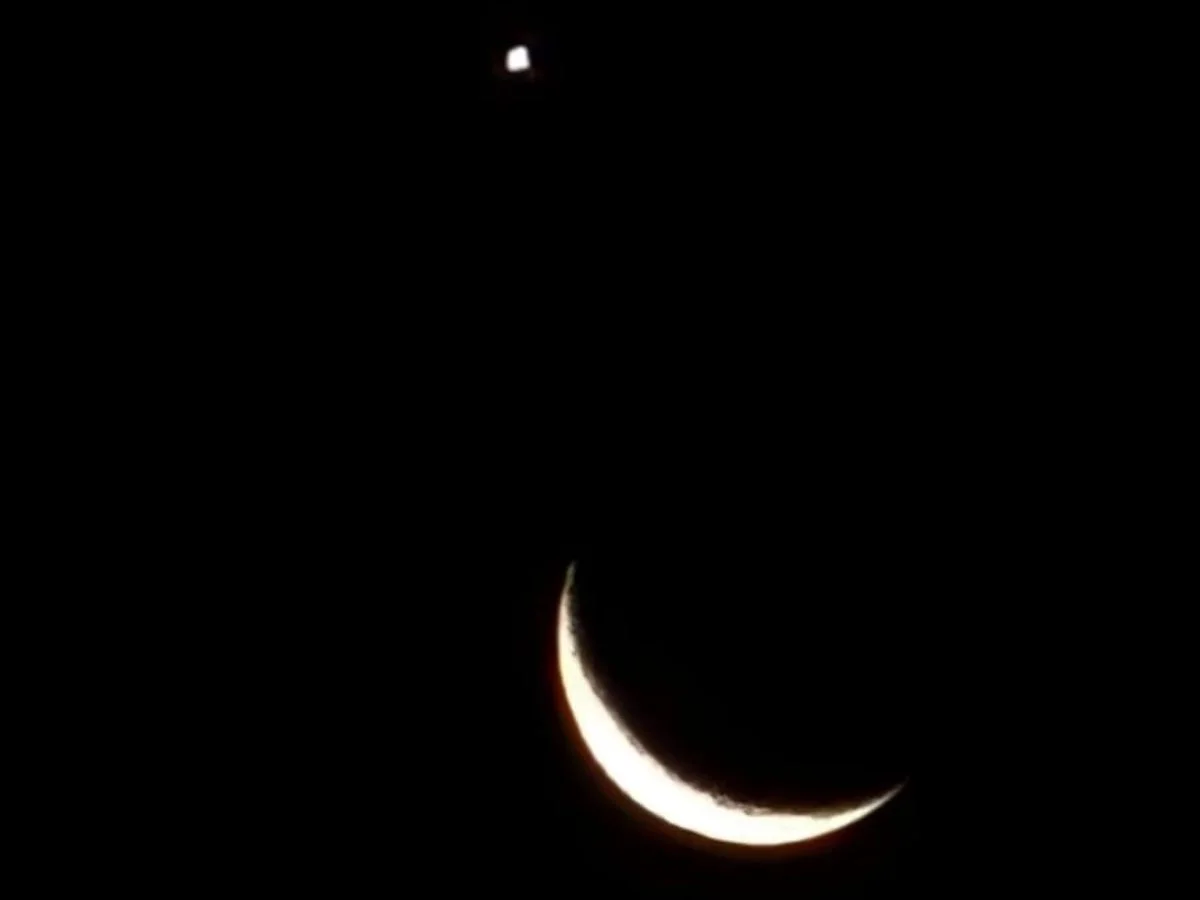
Planet parade in the sky: understand how alignment occurs Anyone who looked up at the western horizon last night caught a rare spectacle: Mercury, Jupiter, Venus, and the Moon lined up in the sky very close together. Those who missed it have another chance this Thursday (18).
The phenomenon repeats after sunset nationwide and can be seen with the naked eye. 🌙 Yesterday's configuration caught attention especially due to the proximity between the thin Moon and Venus, the brightest planet in the group. This type of encounter — three planets aligned with the Moon very close to one of them — is rarer than the alignment of the planets alone, which occurs every 12 or 15 months. Captured by Érika, from Itanhaém Reproduction Why do they appear lined up? The explanation lies in the geometry of the solar system.
All planets visible to the naked eye — Mercury, Venus, Mars, Jupiter, and Saturn — orbit the Sun in planes very close to Earth's. 🌙 The same goes for the Moon.
Since they are nearly parallel, viewed from here on Earth, the Sun, Moon, and planets travel practically the same path in the sky — called the ecliptic, the band where the Zodiac constellations are located. Hence the "corridor" effect between them. What creates this aligned phenomenon is the speed at which each celestial body travels this path.
The Moon is the one that moves most visibly: from one day to the next, it shifts the equivalent of an open hand with an outstretched arm — about 15 degrees of arc. The planets move slower, but each at its own pace, which causes these close configurations to appear and break apart over the days. The rarity occurs when they, at these distinct speeds, align in the sky.
"What we saw yesterday is a rarer phenomenon because they appear aligned, as always, but seemingly very close and with the thin moon, seemingly very close to Venus," explains Josina Nascimento from the National Observatory. What happens in the sky in the coming days? This Thursday (18), right after sunset, the four celestial bodies will appear again on the western horizon. The order, from bottom to top starting from the horizon, will be: Mercury, Jupiter, Venus, and, higher up, the waxing crescent Moon.
Everything will be visible to the naked eye. The essential condition is to have an unobstructed horizon. Mercury and Jupiter appear very close to the horizon and disappear quickly, so anyone with trees, buildings, or hills in the way might not be able to see them.
Venus, higher up and very bright, is the easiest to locate and serves as a reference to find the others. The trio of planets will still be visible until late June and early July, but Mercury and Jupiter will move lower and lower toward the horizon each day — until they vanish for anyone without a clear view.






Sign in to comment on this article.
No approved comments yet.