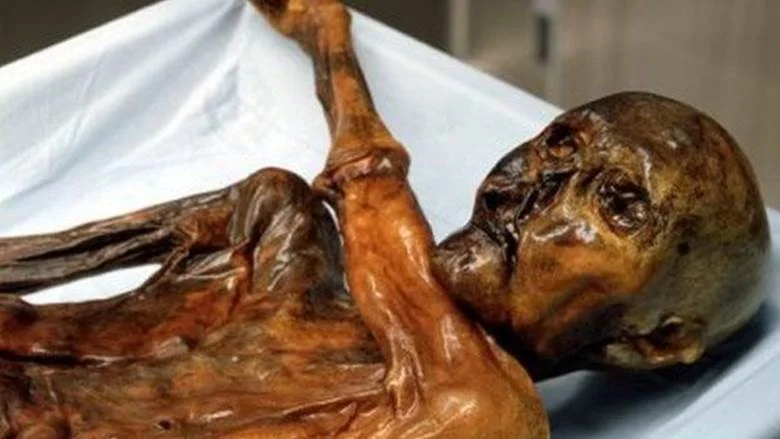
In the intestines of a frozen mummy named Ötzi, discovered in the Alps in 1991, scientists discovered that yeast had developed... with which they made bread. This Bronze Age man, known as "Iceman" and who died after being hit by an arrow in the back 5,300 years ago, underwent an unusual natural mummification process: his cells, literally frozen, preserved their moisture. The body, discovered by hikers on September 19, 1991, in a glacier on the border between Italy and Austria, is so well preserved that it has been a mine of information for researchers ever since.
Ötzi, the 'iceman' mummy, was covered in tattoos Getty Images via BBC His remains, preserved in the museum in Bolzano, Italy, are kept at the same temperature at which they were found: -6 °C These conditions did not prevent microorganisms — both ancient and recent — from remaining active in the frozen body, according to a study published Wednesday in the journal Microbiome. "What we didn't expect was to find yeast," Mohamed Sarhan, lead author of the study and a researcher at the Eurac Research institute in Bolzano, told AFP. "Very good" ferment Scientists discovered four different types of yeast capable of surviving sub-zero temperatures in Ötzi's intestines, on his skin, and in "brownish" water — resulting from the partial thawing of the mummy. These microscopic fungi only live in very cold environments, such as Antarctica or the Alps. Genetic analysis revealed "DNA damage levels very comparable to those of the original microbes" present in the intestines of the "Iceman," suggesting that the yeast arrived there shortly after his death, explains Sarhan. "These yeasts accompanied Ötzi on his long journey through the millennia," notes Frank Maixner, co-author of the study, in a statement. Scientists subsequently reproduced these fungi in a refrigerator.
"When you say you have yeast, people immediately ask: can you use it to make bread?" comments Sarhan. And that is exactly what the team did.
"At first, it didn't work," says the microbiologist. But after three months of trying, "we got a really very good natural sourdough," he states, adding that the team is now considering producing beer. Ötzi, frozen man and preserved as a natural mummy South Tyrol Museum of Archaeology/Creative Commons The study also mentions other, more serious purposes for these microorganisms. When the mummy was discovered, it was initially treated like a normal corpse, using a chemical product, phenol, used to prevent the development of fungi.
But the yeast was able to degrade the phenol. Therefore, scientists believe that in the future, it could be used to break down this chemical in contaminated environments. Scientists find intact cells in mummy skull in RS Fiber and whole grains This fungus was not the only surprising discovery in Ötzi's body.
An analysis of his microbiota revealed the presence of an intestinal bacterium practically nonexistent in modern humans. Although it has disappeared from the stomachs of populations in industrialized countries, it has been detected in some tribes in Africa and South America. It was also found in 3,000-year-old excrement preserved in a salt mine in Hallstatt, Austria, one of the few other sources that allow us to observe ancient human microbiota. Ötzi and these Bronze Age salt miners consumed more fiber and whole grains than modern humans, notes Sarhan. The study concludes that "the Iceman is not a biologically 'frozen' time capsule, but rather a complex ecosystem."
Nikolay Oskolkov, a researcher at the Latvian Institute of Organic Synthesis who did not participate in the study, explains to AFP that it is interesting to note that "the 'iceman' microbiota is not 'frozen'." But the researcher, who had previously discovered fungi in the mummy's intestines, points out that the yeast samples were only collected in 2010 and 2019. This represents "very scarce evidence that the yeasts multiplied over the millennia," he assesses, considering them to be "relatively recent elements in the mummy's body."






Sign in to comment on this article.
No approved comments yet.