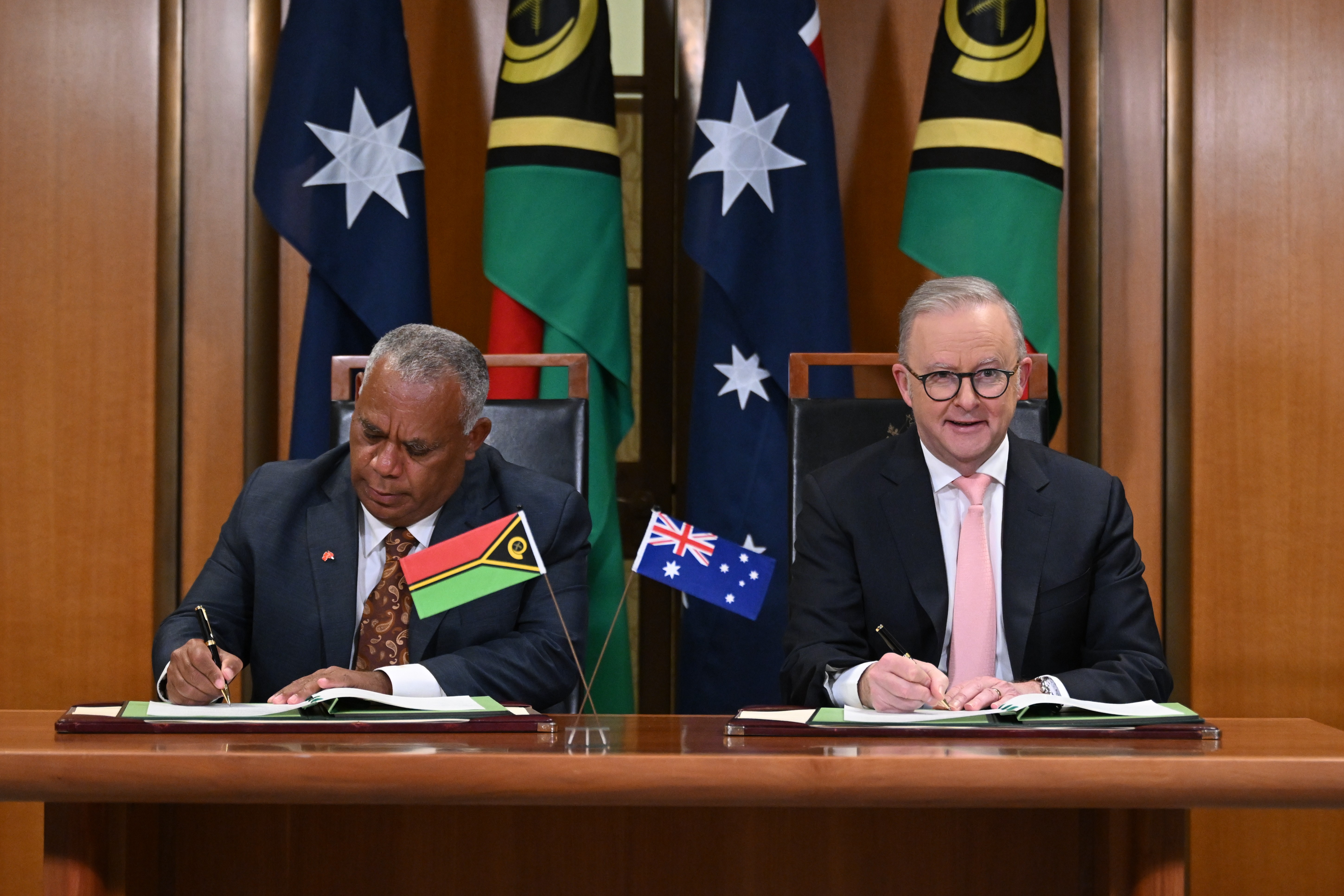
Vanuatu Prime Minister Jotham Napat (left) and Australian Prime Minister Anthony Albanese sign the Nakamal Agreement in Parliament in Canberra.
Lukas Coch/AAP via AP
Australia and Vanuatu signed a long-awaited bilateral security and economic treaty on Monday (29) that prevents China from establishing a military base in the South Pacific island nation.
Australian Prime Minister Anthony Albanese signed the so-called Nakamal Agreement with his Vanuatu counterpart, Jotham Napat, in the Australian capital, nine months after the Vanuatu government rejected a preliminary draft of the text. At the time, the archipelago feared the pact would limit its ability to attract infrastructure investment.
"Our agreement reflects and confirms Australia's role as Vanuatu's largest and most comprehensive economic, security, and development partner, a responsibility we take seriously," Albanese told journalists.
Napat stated that the pact "reaffirms our shared commitment to continuing and strengthening the strategic partnership between our two countries, based on mutual respect, trust, and our shared vision for a peaceful, stable, and prosperous Pacific."
Now on g1
According to a government statement, under the terms of the agreement, Vanuatu will not permit any foreign military base or infrastructure on its territory and will keep its critical infrastructure free from militarization, external interference, or unauthorized access.
The treaty is one of several that Australia has signed or is negotiating with regional neighbors to curb the advance of China's security influence in the region.
Vanuatu will consult Australia when considering third-party participation in its critical infrastructure, but there will be no veto power by Canberra, as initially proposed.
Vanuatu has also committed to prioritizing police cooperation with members of the Pacific Islands Forum, an 18-country and territory bloc that includes Australia. The agreement, however, does not exclude Chinese police. China does not maintain a permanent police presence in the archipelago, but Chinese agents frequently visit the nation of 350,000 residents.
In addition, Vanuatu has agreed to turn first to Australia, New Zealand, and France to respond to major natural disasters.
Australia had proposed providing Vanuatu with 500 million Australian dollars (US$ 344 million) over a decade under the terms of the original draft. Albanese stated that the cost of the final agreement will be made public by December.
Napat advanced that a bilateral agreement Vanuatu is negotiating with China will be released as soon as the pact receives "approval from Beijing." Previously, the prime minister described the so-called Namele Agreement with China as a "comprehensive development cooperation" treaty, assuring it is not a security pact.
Vanuatu has received substantial loans and humanitarian aid from China for the construction of buildings, ports, and other infrastructure works.
"At the moment, it has not been signed yet. We will share the (Namele) agreement. There is nothing to hide. Our government is transparent, and I am very grateful that the Prime Minister (Albanese) also gave me authorization to share the Nakamal Agreement with them (China)," Napat said.
In September of last year, Albanese was notified that the previous version of the pact had been rejected just hours before boarding a flight to Vanuatu for the signing ceremony.
Australia and Vanuatu sign agreement blocking Chinese military base
Vanuatu Prime Minister Jotham Napat (left) and Australian Prime Minister Anthony Albanese sign the Nakamal Agreement in Parliament in Canberra. Lukas Coch/AAP via AP Australia and Vanuatu signed on Monday (29) an a...


Sign in to comment on this article.
No approved comments yet.