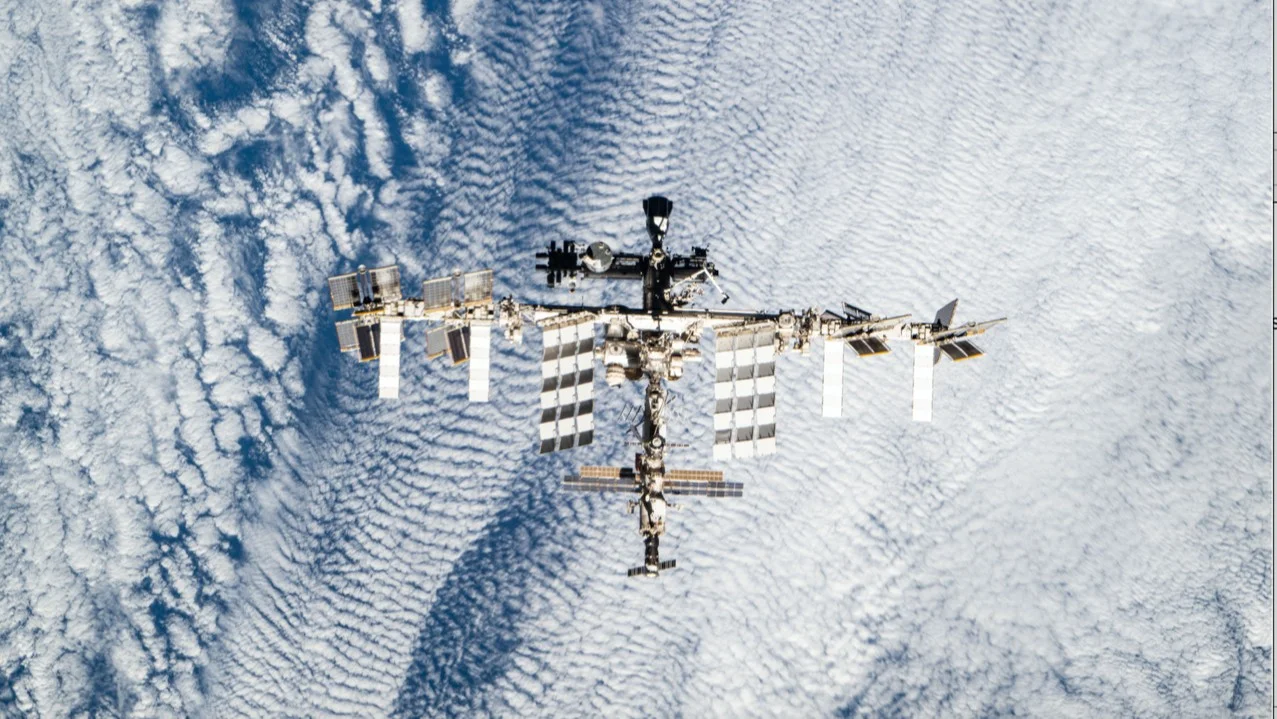
The ISS orbits Earth at an average altitude of about 400 km above the surface NASA An air leak recently detected on the International Space Station (ISS) that forced five of the seven astronauts in orbit to temporarily take refuge in a safe area of the complex has reignited fears about the security of the structure. Small leaks at the station have been monitored since 2019. According to NASA, air leaks have been relatively small in recent months, but intensified last Friday (5). NASA announces crew members for Artemis III, test mission for future trips to the Moon At the time, five astronauts spent about two hours sheltered in SpaceX's Dragon "Freedom" capsule, docked to the station — known as a "safe haven" — ready to return to Earth if the situation worsened.
The measure was taken as a precaution after an air leak was detected in the Russian section of the station. During this time, two Russian cosmonauts remained on the station to make repairs. NASA's decision to end the confinement came after the Russian space agency Roscosmos temporarily suspended repair work on the PrK transfer tunnel, connected to the Zvezda service module, stating it needed to analyze new data and measurements regarding the leak.
It has not yet been disclosed when a new repair attempt will be made. Now on g1 NASA reported that the issue has been present in this module "for some time" and emphasized that it will continue to collaborate with the Russian agency to address the issue jointly. "The safety of the crew and on-board systems is not at risk; the pressure inside the ISS is stable and remains at the expected level," Roscosmos reported. How exceptional is an air leak on the ISS? According to space industry experts, this type of occurrence is not as surprising as it seems. "You always have to keep in mind the size of the ISS," explains Jan Wörner, former director of the European Space Agency (ESA).
"In such a large infrastructure, there are always certain leak rates at the connections." The greater risk arises when there is a localized failure in materials, such as seals or joints, which can cause air loss to evolve unpredictably. In such cases, temporary evacuations are part of safety protocols. Wear and tear after years of use The Russian Zvezda module, the central piece of the incident, shows signs of wear after decades of use.
Specialist Georgi Trishkin points out the presence of micro-cracks in old welds and other structural defects. "The main problem is the wear and tear of the docking area," he stated. The module has undergone 66 dockings — more than any other on the station — and each operation puts additional strain on the structure. These leaks have been recorded for approximately seven years, with varying repair outcomes.
This time, it is a new leak, unrelated to previous fixes, which makes identifying the cause more complex. Onboard crew and operations Currently, the ISS hosts the four members of the SpaceX Crew-12 mission — including Russian cosmonaut Andrey Fedyaev —, NASA astronaut Chris Williams, and two other Russian cosmonauts. The Zvezda module, launched in 2000, performs essential functions such as life support, flight control, power supply, and docking for Soyuz and Progress spacecraft. Despite geopolitical tensions, especially Russia's war against Ukraine, international cooperation on the station continues to involve the United States, Russia, Canada, Japan, and the ESA. According to operator SpaceX, the Dragon spacecraft has a capacity of up to seven people. Future of the station NASA plans to end International Space Station operations by the end of 2030 and deorbit it in 2031, after more than three decades of service since its launch in 1998.
The agency intends to replace the ISS with commercial low-Earth orbit platforms to continue microgravity research and technological testing. Meanwhile, incidents like this reinforce both the challenges and the robustness of one of the greatest achievements of international scientific collaboration.






Sign in to comment on this article.
No approved comments yet.