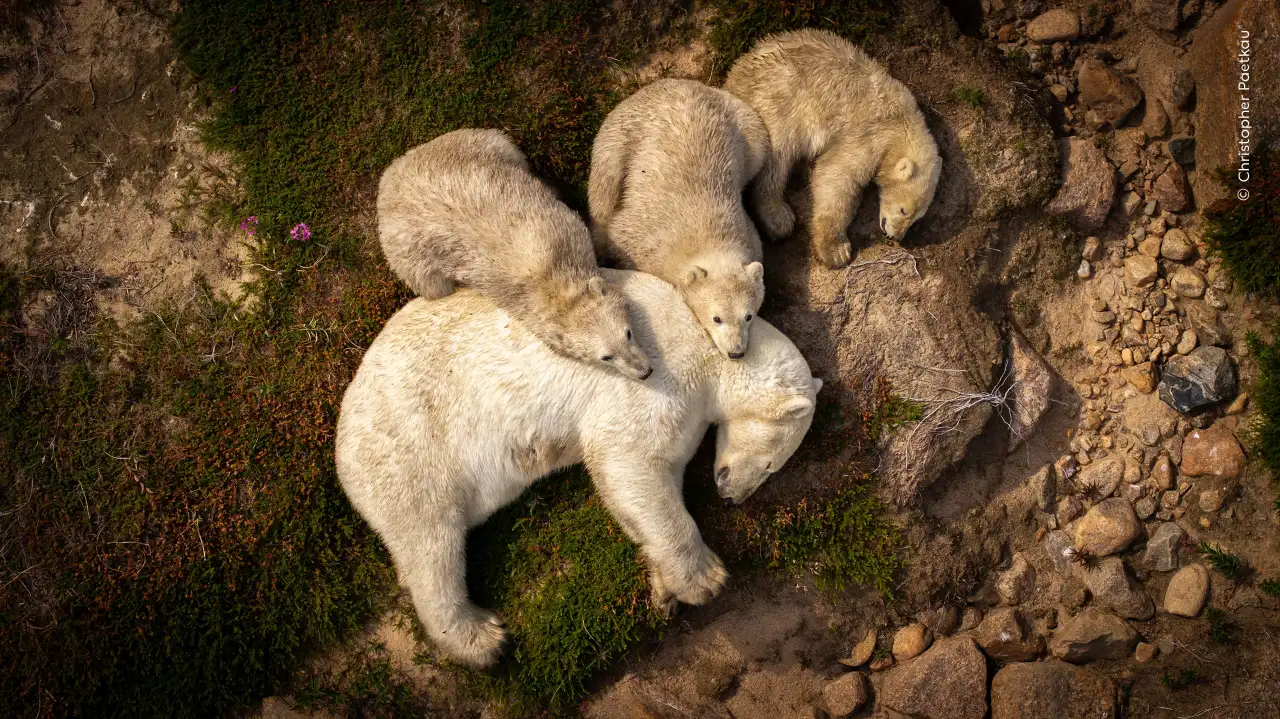
A polar bear and her three cubs rest during the summer in northern Canada. Christopher Paetkau – Wildlife Photographer of the Year – People’s Choice Award 2026 The origin of the cells that make up the bodies of animals, plants, fungi, and a huge variety of microscopic beings may have been much more eventful than previously imagined. Instead of a single decisive encounter between two microorganisms, a study published this Wednesday (10) in the scientific journal "Nature" suggests that these complex cells emerged gradually, the result of a succession of "alliances" between different microbes — and that even giant viruses may have participated in the process, acting as a sort of gene delivery system. "For a long time, we explained the origin of complex cells as a story with two main protagonists: an archaeon and the bacterium that gave rise to the mitochondria," says Toni Gabaldón, a researcher at the Institute for Research in Biomedicine (IRB Barcelona) and the Barcelona Supercomputing Center (BSC) in Spain, who led the work. "Our study suggests that this narrative is incomplete and that there were more actors on the scene, including other groups of bacteria and giant viruses that may have facilitated gene exchange." All cells of animals, plants, and fungi share a basic characteristic: they are complex cells with specialized internal compartments — the so-called eukaryotic cells.
How they arose is one of biology's biggest open questions. For decades, the most widely accepted explanation pointed to a decisive moment: an archaeon (a type of microorganism) would have associated with a bacterium, which over time turned into the mitochondria, the structure that acts as the cell's energy power plant.
This "marriage", proposed and championed by biologist Lynn Margulis, would have opened the doors to cellular complexity. Trending videos on g1 Fossils written in genes The new work does not deny the central role of the mitochondria, but argues that the path to the complex cell was longer, more gradual, and more collaborative than previously believed. Since this process occurred about 2 billion years ago, in microscopic beings that left virtually no fossils, the team resorted to a sort of "molecular archeology": instead of bones, they analyzed the traces preserved in current genomes.
Using the MareNostrum supercomputer for over five years, the scientists reconstructed the set of genes of the last common ancestor of all eukaryotes (known by the acronym LECA) and compared it with tens of thousands of genomes from bacteria, archaea, and viruses. NASA investigates anomaly in Earth's magnetic field that could cause chaos in communications Electron micrograph of a Mimivirus, one of the so-called giant viruses. The new study suggests that viruses of this type may have acted in the past as vehicles for gene transfer between microbes. Sarah Duponchel and Matthias G.
Fischer/Wikimedia Commons "We are trying to reconstruct a history that happened billions of years ago and for which we have no direct fossils. That is why we were very conservative: we kept only the most robust evolutionary signals — those with a force comparable to that of the signals already accepted for the ancestral archaeon and the bacterium that gave rise to the mitochondria," explain Moisès Bernabeu, Saioa Manzano-Morales, and Marina Marcet-Houben, study authors and researchers from the Comparative Genomics group led by Gabaldón. In addition to the mitochondria, the study identified the signatures of at least two other groups of bacteria in the origin of eukaryotes. One of them, called Planctomycetota, stands out for an unusual complexity for a bacterium, with internal compartments similar to those of more sophisticated cells.
The other, Myxococcota, is linked to metabolic functions, such as fat processing and membrane formation. According to the researchers, these contributions did not all come at once: the signals from Planctomycetota are the oldest; whereas those from Myxococcota and the bacterium that originated the mitochondria appear closer in time. This picture matches the idea that the ancestors of complex cells lived in environments teeming with microbes, such as so-called microbial mats — layered communities where different organisms coexist under varied chemical conditions.
In this kind of neighborhood, the exchange of genes between distinct beings would have allowed the future complex cell to gain new capabilities over time. Living cells of the moss leaf Bryum capillare seen under a microscope. The image shows chloroplasts, structures present in plant and algal cells. Des_Callaghan/Wikimedia Commons One of the most unexpected discoveries involves viruses precisely.
Part of the genes incorporated in the initial stages of this evolution appears to have come from giant viruses, of the Nucleocytoviricota group, which have much larger genomes than most known viruses and infect single-celled organisms. For the authors, these viruses may have functioned as vehicles of genetic transfer, carrying material from one microorganism to another within the same environment. The work continues a line of research that Gabaldón himself opened in 2016, also in "Nature", when he suggested that the mitochondria may have been acquired relatively late in this process.
With much more genomic data and more powerful computing tools, the team has now managed to detail which other organisms left their mark on this common ancestor. In the future, the authors say, this type of knowledge could even pave the way for research in biotechnology aimed at developing artificial life forms from sets of microorganisms. "All genomes preserve remnants of their history.
In the case of eukaryotes, these remnants tell us of ancient alliances between microorganisms. Understanding them helps us answer a very profound question: what we are and where we came from," Gabaldón concludes. VIDEO: Does pollution really make the sky look prettier? Does pollution really make the sky look prettier?.



Sign in to comment on this article.
No approved comments yet.