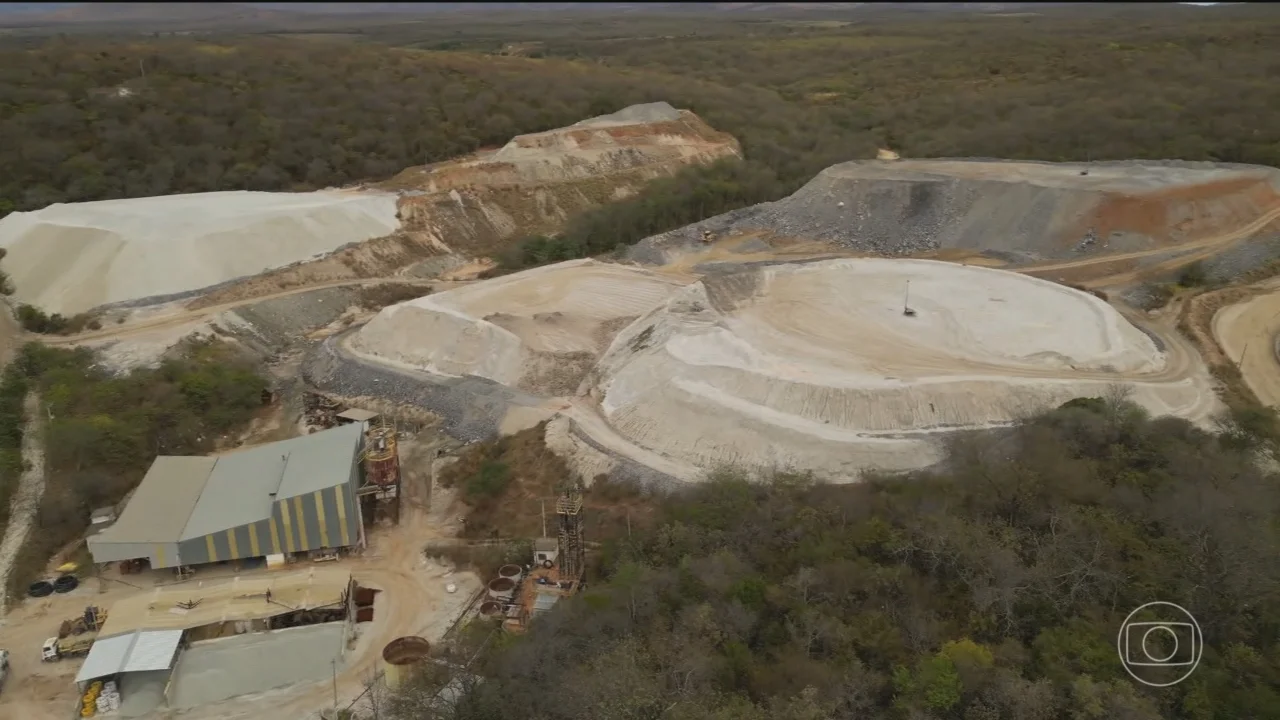
Critical minerals: project approved in the Chamber wants to ensure that Brazil is not just an exporter of raw materials Jornal Nacional/ Reproduction While working to diversify its sources of supply for critical minerals, the European Union is betting on Brazil as a strategic partner and claims to have a proposal that is more "beneficial" than that of other actors in the dispute for Brazilian raw materials, European Commissioner for International Partnerships, Jozef Síkela, told Reuters. The commissioner visited the rare earth research and processing center of the Australian mining company Viridis Mining and Minerals in Poços de Caldas (MG) on Saturday, one of the four priority projects selected to accelerate collaboration between the EU and Brazil. 🗒️Do you have a story suggestion? Send it to g1 Síkela assesses that the European approach is an asset because it prioritizes business sustainability and incentives for local rare earth processing. This aligns with a Brazilian government guideline to produce and export processed minerals that add technology and value to the production chain of a nascent sector in Brazil, which holds the second-largest global reserve of such critical minerals. "It is extremely important that Brazil also advances beyond low-margin businesses, that is, that value is created here in the country," said the commissioner in an interview during the visit to the Viridis unit, highlighting that Brazil is currently the EU's most strategic partner in Latin America and an expanding economy. "We can cover our needs based on purchase agreements, and Brazil will have its own refining capacity, new technologies, and, basically, will move up the supply chain to generate higher margins." Brazil is experiencing a strategic opportunity with critical minerals, says ambassador The Viridis pilot project, inaugurated in May, has the capacity to process 100 kg of ore per hour and produce up to 2.92 kg of mixed rare earth carbonate (MREC) per year, a whitish powder that contains a mixture of rare earth elements that have not yet been separated. Viridis now plans to invest US$360 million to build its commercial plant with the capacity to produce 15,000 tons of MREC per year starting in 2028.
The Viridis Colossus project in Minas Gerais comprises a total of 228.62 km² of licenses. "And that is why I like this particular project (from Viridis) so much, because it basically delivers objectives: it creates jobs, creates new partnerships, brings new technologies, education, and knowledge transfer, all based on the most advanced environmental, social, and technical standards," stated Síkela. Agreement in sight He also highlighted the non-binding letter of intent signed this month between Viridis and the Belgian chemical company Solvay, which provides for the supply of MREC and could evolve into a broader partnership, including technological support in processing. Viridis CEO Rafael Moreno told Reuters that discussions with the European Union regarding support for the project are advanced, and that an agreement with Solvay could be closed by the end of July. According to him, the EU could help with financing and price protection mechanisms to reduce risks and ensure competitiveness. "A minimum price is important, so finalizing all these details will be important for us, and that is not far from happening," said Moreno, without mentioning deadlines. Síkela stated that his role is to offer political support and risk mitigation instruments, without replacing private capital. "We are not coming to replace private financing nor as providers of equity capital, but our role is to help mobilize private investments," he stated, without giving details. The progress of Viridis in Brazil occurs amidst a global race for rare earths and critical minerals, as governments in Europe and the United States try to reduce their dependence on China -- the largest producer -- for these materials, which are vital for electric cars and defense systems. Diversification in the West Asked about the scenario, Síkela stated that it is not just about China and explained that the European strategy seeks to reduce "dependencies" in global supply chains, following shocks like the pandemic and the war in Ukraine. In addition to rare earths, Síkela said without naming names that the EU sees projects involving other critical minerals, such as nickel and lithium, as priorities in Brazil, and indicated that there are plans to advance a memorandum of understanding between the bloc and the Brazilian government, although the details are still under negotiation. Asked if he might be arriving late in the dispute for assets in Brazil, after the United States and China have made important advances, the commissioner said that "our value proposition is more beneficial than that of others.
First, it is more sustainable. The second thing is job creation and education," he stated. "We must not forget that Brazil is a global environmental actor, with the rainforest, with the Amazon, with the resources.
So, whatever Brazil does, if it does it right, it will have a global impact. And, if it does it wrong, it will have a negative impact.
Therefore, what we want to do is help with environmental, social, and governance standards, because that matters to us," he stated. The CEO of Viridis, in turn, said that the company is in line with European guidelines to think of a diversified market for the rare earth production chain. "We are adopting an approach where we want everyone to have rights, whether in Argentina, Paraguay, Europe, or Australia..
therefore, we are pleased to maintain a European or Western mindset -- or, more importantly, a Western mindset," said Moreno. At the end of last month, the executive told Reuters that Viridis was in advanced negotiations with potential buyers of critical minerals in Europe and the US, adding that the company was not seeking Chinese buyers.




Sign in to comment on this article.
No approved comments yet.