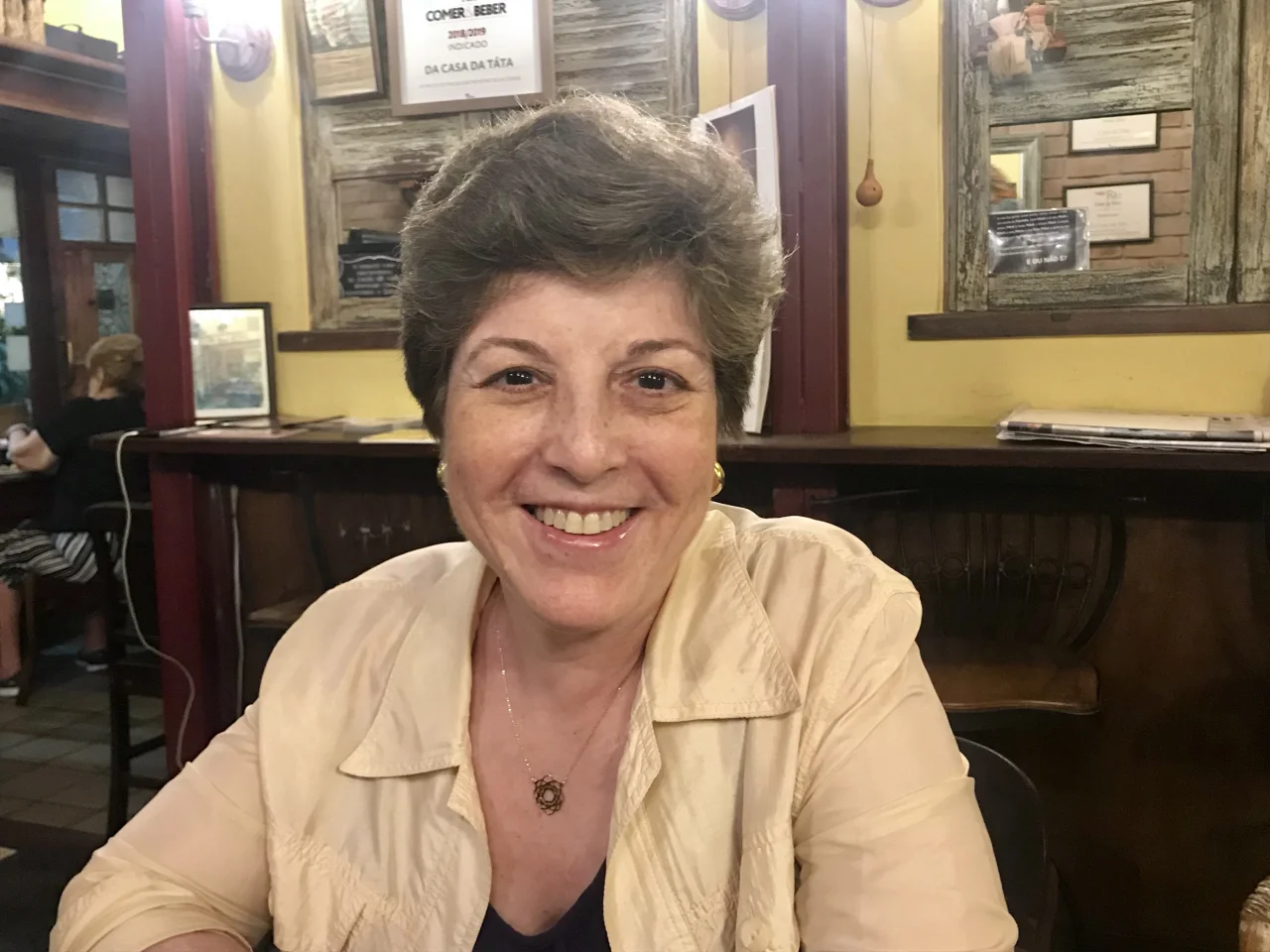
Most people have long-standing friends, almost always from youth, and as they age, they resent that their circle of relationships is shrinking. I am very fortunate to have made friends in maturity, and today's column is dedicated to one of them: physician Claudia Burlá, who passed away prematurely at the age of 64 on June 16.
A geriatrician with a doctorate in bioethics and a national reference in the field of palliative care, she was one of the first interviewees on the program 50 Mais CBN, which I co-anchored with physician and gerontologist Alexandre Kalache and fellow journalist Mara Luquet. I went to check the date: June 20, 2015.
Gradually, from an interviewee, she became a friend. It was impossible not to be enchanted by her intelligence and passion for her profession.
Regarding palliative care — which I have so often addressed in this space — she had a quintessential statement: Geriatrician Claudia Burlá: “It is when people think there is nothing more to do that palliative care can make all the difference” Mariza Tavares “It is when people think there is nothing more to do that palliative care can make all the difference for a person until the end of their life.” These were not just words.
It was her daily routine as a physician, speaker, professor, mentor. In recent days, I re-read five years of exchanged messages stored on my cell phone.
From March 2021, when we wrote about the climate of fear and helplessness during the pandemic, until the end of May this year, when we organized our last dinner together. I cannot imagine this void in communication.
We shared impressions about the congresses we attended together or watched online. We shared articles — and, generously, she forwarded many of my g1 columns to other healthcare professionals — and, of course, tips on movies, series, and books.
I would ask for recommendations of doctors for friends, or specialists to be interviewed, and I knew that any name Claudia suggested was among the best in her specialty. Our favorite pastime was going to a good Japanese restaurant, where she would invariably order a caipirinha, because she was a connoisseur of fine cachaças.
In 2022, a brain cancer diagnosis forced her to undergo delicate surgery. She told me she was immersed in developing the "necessary reframings to survive with the dignity she had always defended."
Now she was living the role of a patient and noting, with her usual lucidity: “Having a label with the name of a serious illness is very heavy, but I remain my own protagonist and actively participate in all decisions.” Gradually, she resumed her activities, including seeing patients in her office.
In November 2024, her 63rd birthday was celebrated with recent and old friends (of course I was there!). In September 2025, we had a chat at the launch of my latest book, Life after 60: get ready to create your best version.
She had read the first — and more than imperfect — version of the work, making countless valuable suggestions. Endowed with endless curiosity, she started taking tambourine classes and, recently, had taken a course on AI in medicine.
However, 2026 brought bad news. The cancer had spread in her brain again.
Claudia faced a new surgery and we managed to meet a few times, but at the beginning of this month, her condition deteriorated rapidly. She left following her own rules, the master of her destiny.
At her wake, everyone repeated the same words to remember her: professional rigor and soundness, integrity, generosity. I wish we had had the strength to turn that moment into a celebration.
I want to leave here a memory that serves as a guide for all of us: an excerpt from a column I wrote when she participated in the 2019 GeriatRio edition. In her presentation, she said she had found inspiration in the painter Frida Kahlo, who died at just 47 after enduring atrocious pain resulting from polio and a severe traffic accident.
Here is the text: “The name Frida summarizes what relates to the aging process. The F stands for functionality, the power of the body which, with old age, declines and lowers its guard, allowing illnesses to occur and a progressive decline to take place.
The R stands for resilience, which implies acceptance and adaptation regarding new situations and restrictions. The I stands for insufficiency, when one moves toward an irreversible condition, with a daily life of limitations leading up to total dependence.
The D stands for dignity, the desire of every human being, which can be compromised throughout our journey. Finally, the A stands for autonomy which, after full health, is our greatest asset.
It means living according to my rules and my values.” This is the legacy of Claudia Burlá, which, I am sure, many who knew her will try to keep alive. Mariza Tavares and Claudia Burlá at the book launch of Life after 60 – get ready to create your best version Personal archive.





Sign in to comment on this article.
No approved comments yet.