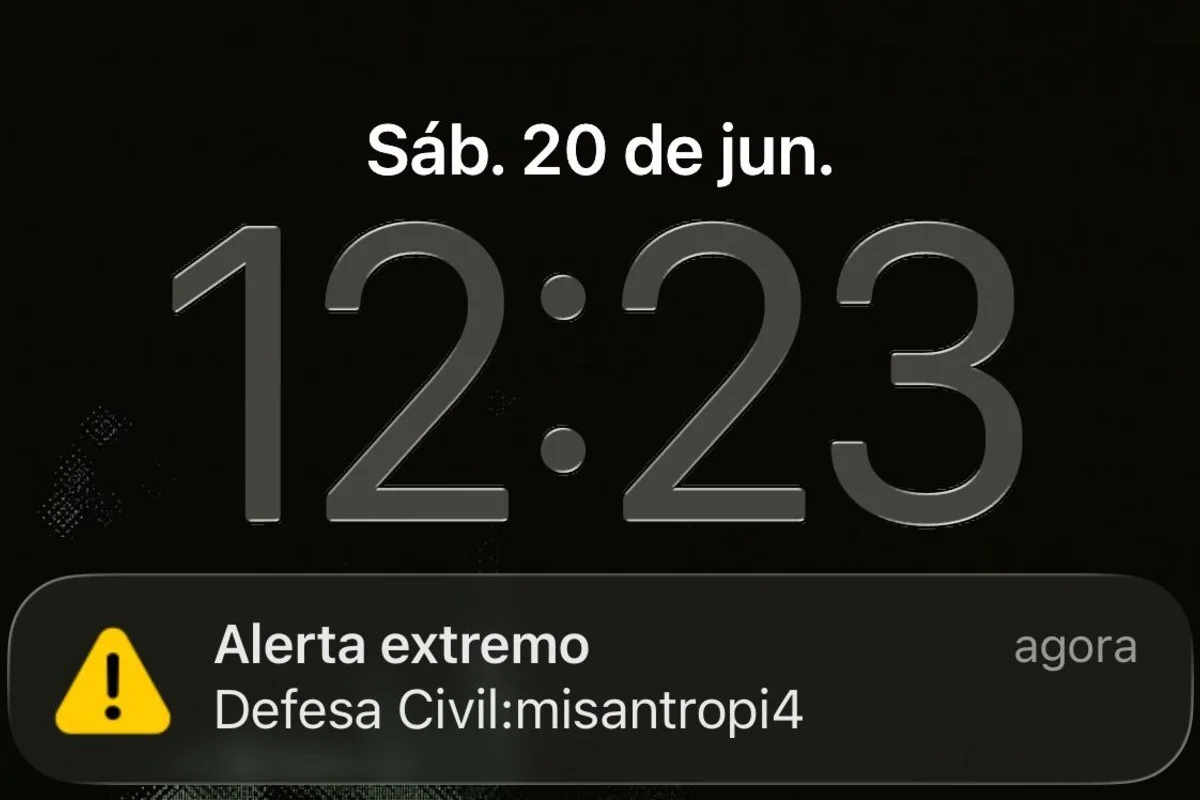
Civil Defense Secretary speaks about fake alerts triggered in the early hours After the scare caused by the sound alert sent to cell phones in different regions of Brazil in the early hours of this Saturday (20), a question began to circulate among residents: why did some people receive the message and others did not, even while being in the same city or in neighboring municipalities? 📳 The answer lies in how the system used to trigger this type of warning works. The Civil Defense Alert uses Cell Broadcast technology, which allows sending emergency messages to cell phones connected to the mobile network within a specific area.
But this does not mean that the warning is delivered based on each person's exact address or the precise location of the device, as happens in map applications. Civil Defense alert with the word "misanthropy" rang on the cell phones of residents of Campo Grande. Reproduction According to Thiago Ayub, technology director at Sage Networks, the system allows Civil Defense technicians to draw areas on the map to define who should receive the message. It is also possible to select an entire municipality from a pre-configured list.
From there, the alert is distributed by the cell phone towers that serve that region. This helps explain why residents of different neighborhoods in the same city may have had different experiences. If the area selected on the map does not cover the entire municipality, some neighborhoods may be left out of the scope defined for the trigger.
In metropolitan regions, the same logic applies to neighboring cities: one may be within the triggered area and another, even if nearby, may be left out. READ ALSO: What is 'misanthropy'? Understand the meaning of the word that appeared in the National Civil Defense alert Why did the Civil Defense alert ring loudly in the early hours even with the cell phone on silent? In the case of the improper alert sent during the early hours, the National Civil Defense reported that the platform was taken offline at 1:30 AM after suffering an invasion. According to the agency, the trigger was done remotely by someone outside the National System for Protection and Civil Defense and it is likely a hacker attack.
The message, classified as an “Extreme Alert”, contained the word “misanthropy” [the meaning of which is 'rejection of humanity'] and was not linked to any real risk situation. Does the system look at the cell phone or the antenna? According to Ayub, the determining factor for receiving the message is the location of the cell phone antenna—technically called a Base Transceiver Station (BTS)—and not the exact location of the device. This means that the cell phone receives the alert because it is connected to an antenna that was included in the trigger. For this reason, a person who is near the border between two municipalities may receive a message intended for the neighboring city, if the cell phone is being served by an antenna located in that area. The reverse can also occur, although it is less common: a person within an area that, in theory, should receive the alert may be left out if they are connected to an antenna that was not included in the trigger scope, if they are without mobile signal, or if the device is not compatible with the technology. That is why the system may seem irregular to the user.
For those looking from the point of view of the neighborhood, street, or building, the natural question is: “why did my neighbor receive it and I didn't?”. From a technical point of view, however, delivery depends on the mobile network and the antenna that was serving each device at that moment. Map of regions that received alerts from the National Civil Defense Gabriel Wesley Marques Santos/Art g1 Why can neighboring cities have different results? In metropolitan regions, where municipalities are adjacent to each other, the difference in reach can be even more noticeable.
An alert can be sent to a specific city, to an area drawn on the map, or to a set of antennas that serves a certain region. Since cell phone antennas do not necessarily respect the administrative division between neighborhoods and municipalities, coverage can cross borders. An antenna installed in one city can serve devices that are close to the border with another.
Likewise, a neighboring city may not receive the warning if its antennas are not within the area selected for the trigger. According to Ayub, the system operator can choose an area on the map or select a municipality from a pre-configured list. In the case of the invasion investigated by the National Civil Defense, only the analysis of the command history will be able to confirm which areas were selected by whoever made the improper trigger. Cell phones in Acre also received an alert with the word 'misanthropy' on Friday night (19) Pedro Marcelo/Rede Amazônica Acre What can prevent a person from receiving the alert? In addition to the selected area and the antenna to which the cell phone is connected, other factors can interfere with receiving the message. Cell phones without signal at the time of the trigger, in airplane mode, or connected only to Wi-Fi may not receive the alert.
Very old devices, imported models without Anatel certification, or phones incompatible with the technology used by the system may also be left out. There is also the possibility that the user themselves has deactivated emergency alerts in the device settings. In some cases, according to Ayub, cell phones without VoLTE support—technology used in 4G and 5G networks for voice calls—or connected to antennas without this feature may fail to receive the message if they are on a long call at the time of the trigger. This does not mean, however, that the system depends on the internet, an app, or prior registration.
The Civil Defense Alert was created to work over the mobile network, without requiring the user to download an app or sign up for a database. Is it possible to know who received it? The system allows for subsequent auditing of which antennas received the message, on what date and time, and distributed the alert to the cell phones connected to them during that period, according to Ayub. g1 contacted the Ministry of Integration and Regional Development (MIDR), responsible for the National Secretariat for Protection and Civil Defense, to find out which regions were effectively reached by the improper trigger, if there is an estimate of how many cell phones received the message, which areas were selected in the system, and if the investigation will also determine why the alert reached some neighborhoods and cities but not others. The report will be updated if there is a response. But there is an important limitation: there is no individual delivery receipt on each device. In other words, it is possible to identify which antennas were triggered and which regions were technically reached, but not necessarily to confirm, cell phone by cell phone, who actually saw or received the warning. This difference is important to understand the case from the early hours. The investigation will be able to point out which areas or antennas were used in the improper trigger, but each resident's experience may vary according to the network, the device, the phone's configuration, and the antenna to which the cell phone was connected at the time. What happened in the early hours The alert sent between Friday night (19) and the early hours of this Saturday (20) scared residents of several cities because it appeared at a high volume, like a siren, even on cell phones that were in silent mode, and insistently, until the user viewed and interrupted the warning on the screen. The message contained the word “misanthropy”, which means aversion, distrust, or rejection of humanity. The term can also be associated with social isolation, melancholy, or deep sadness. In the context of the alert, however, the word had no relation to any public emergency. The National Civil Defense reported that the Civil Defense Alert platform was taken offline after an invasion and that the Federal Police will be notified. According to the agency, the system will only be reconnected when security conditions are re-established.






Sign in to comment on this article.
No approved comments yet.