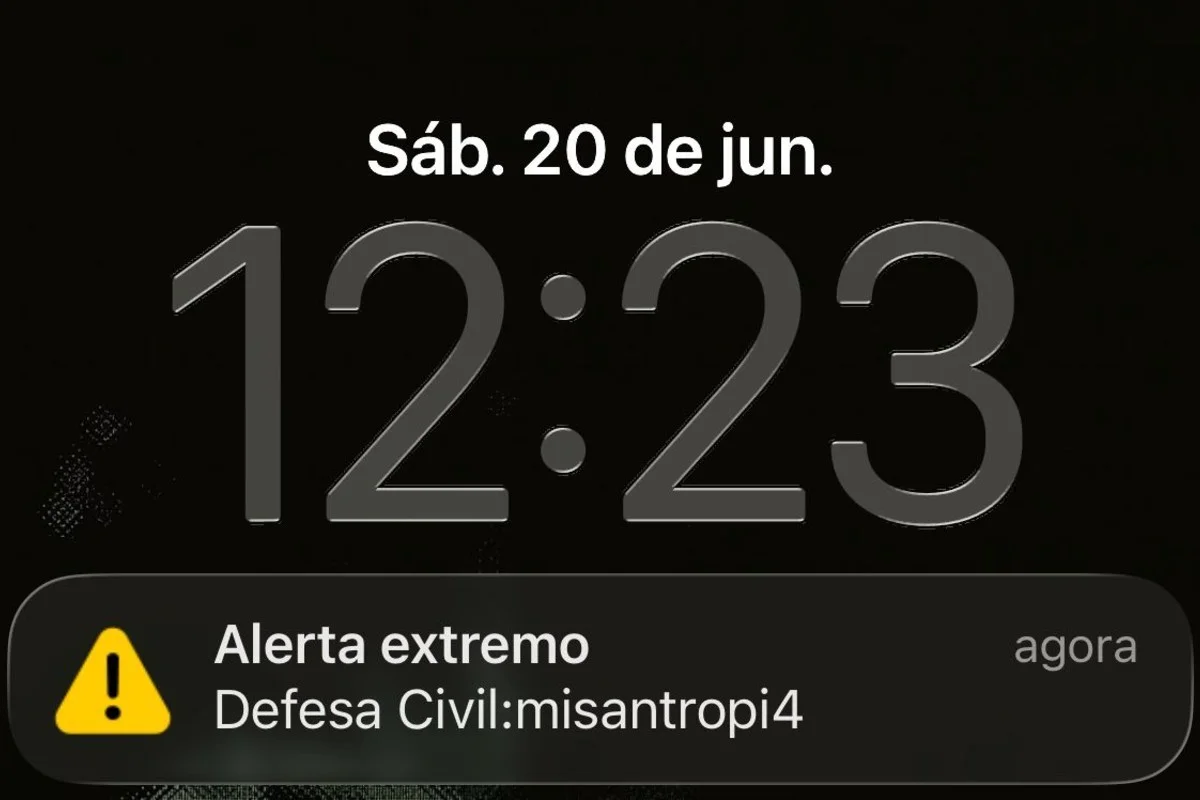
Why did the alert sound so loudly this dawn? The sound alert sent to cell phones in different cities in Brazil between Friday night (19) and the early hours of this Saturday (20) caused a scare not only because of the message's content, but also because of the way it appeared: at a high volume, like a siren that kept playing until the user viewed the message and stopped the warning, including on devices that were in silent mode. The explanation lies in the system's own operation. Defesa Civil Alerta, the platform used for emergency warnings to the population, was designed to bypass common cell phone barriers in extreme risk situations.
When a message is classified as an "extreme alert," the warning can sound at a high volume and override the normal use of the device, with the intention of drawing the attention of anyone in an area under threat. In the case of this early morning, however, the message did not correspond to a real risk situation. The National Civil Defense reported that the platform was taken offline at 1:30 AM after suffering an invasion and triggering an alert to various regions of the country. According to the agency, the sending was ordered remotely by someone outside the National System for Protection and Civil Defense and is likely a hacker attack. The triggered message was of the "Extreme Alert" type and featured the word "misanthropy", with no relation to natural disasters, severe weather events, or any population protection guidelines. The National Secretariat for Protection and Civil Defense stated that it will contact the Federal Police and that the system will only be turned back on when security conditions are re-established. Civil Defense alert with the word "misanthropy" rang on the cell phones of residents in Campo Grande. Reproduction How Defesa Civil Alerta works Defesa Civil Alerta is a public system created to send emergency warnings to cell phones located in risk areas.
It is used in situations such as intense rain, floods, flash floods, waterlogging, landslides, windstorms, and other events capable of putting the population in danger. The technology behind the tool is called Cell Broadcast. Unlike ordinary SMS messages or app notifications, it does not send the alert to individually registered numbers.
The warning is broadcast by cell phone towers to all compatible devices connected to the mobile network in a given area. This allows the Civil Defense to send a message to a specific region, delimited by technical and geographical criteria. Anyone in that area, with a compatible cell phone and connected to the mobile network, can receive the warning automatically. Therefore, the system does not require prior registration, an installed app, an active data package, or an internet connection.
The logic is to quickly reach the largest possible number of people in an area at risk, including those who have not signed up for SMS alert services. Why does it sound even on silent? The central point is the alert level. According to the rules of Defesa Civil Alerta, there are differences between the types of warnings.
In severe alerts, the cell phone may emit a simpler sound, similar to that of an ordinary message, and the warning does not necessarily sound if the device is on silent. As for extreme alerts, the logic is different. The message triggers a louder sound, similar to a siren, even if the cell phone is in silent mode.
This happens because this type of alert is reserved for situations where there is imminent or very severe risk to the life and safety of the population. The idea is that, in the face of a real risk — such as a sudden flood, landslide, or extreme event — the person is warned even if they are sleeping, with their phone locked, using another app, or with common notifications disabled. It was this safety feature that caused the false alert to cause so much panic during the early morning. Because the message was classified as extreme, cell phones reacted as they would in a real emergency. Does the alert depend on the internet? No.
Defesa Civil Alerta does not depend on internet, Wi-Fi, or an app. The message arrives via the mobile phone network, using Cell Broadcast technology. This also explains why several people received the warning at the same time in different cities.
The dispatch does not work like an individual conversation between sender and recipient, but as a broadcast directed by the towers to the devices within the defined area. To receive the alert, the cell phone must be compatible with the technology and connected to an appropriate mobile network at the time of sending. Anyone who is only on Wi-Fi, without a connection to the telephone network, outside the delimited area, or with an incompatible device may not receive the message. Can you turn off this type of alert? On some cell phones, there are settings related to emergency alerts and government alerts.
However, civil defense authorities recommend that these warnings remain activated, because they are used in situations where quick information can prevent deaths. The extreme alert is a category designed for serious risk. Therefore, it takes priority over common device settings, such as silent mode or the use of other apps. The invasion reported by the National Civil Defense exposes a security flaw in the use of the platform, but does not change the purpose of the system: to warn the population quickly in situations of real danger. What happened this early morning Residents of several cities reported receiving messages with the word "misanthropy" or variations of the term.
The content did not contain protection guidance, indication of a risk area, or any relation to weather phenomena. According to the Michaelis dictionary, misanthropy means aversion, distrust, or rejection of humanity. The term can also be associated with social isolation, melancholy, or deep sadness.
State and municipal civil defenses, such as those in São Paulo, Rio de Janeiro, Paraná, and Salvador, stated that they were not responsible for the dispatch and said there was no risk situation at the time that would justify an extreme alert. The National Civil Defense stated that the platform was taken offline after the invasion. According to the agency, the Federal Police will be called in to investigate the case.






Sign in to comment on this article.
No approved comments yet.