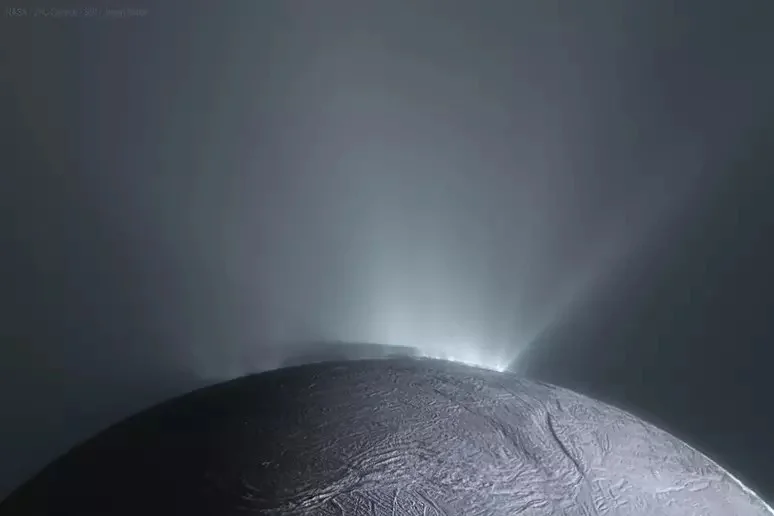
Future missions could collect samples from environments that may harbor life, such as Enceladus, one of Saturn's moons: spatial orientation of molecules and diversity between simple and complex forms are among the possible clues that are easiest to obtain. https://www.terra.com.br/noticias/cientistas-propoem-metodo-da-ecologia-para-saber-se-luas-geladas-do-sistema-solar-podem-abrigar-vida,a55db6fb5b96f56aa190b87cbf141ac142zzo289.html?utm_source=clipboard Jason Major, Cassini spacecraft/Flickr, CC BY-NC-SA New observatories and space missions are investigating environments in our Solar System that could harbor life, but which have long remained hidden.
Icy moons like Saturn's Enceladus and Jupiter's Europa likely have large oceans beneath their frozen outer crusts. But thick layers of ice prevent space probes from collecting samples directly.
Exploring these icy moons is almost forensic work: their surfaces maintain a partial record of inaccessible interiors. Thus, scientists need tools that help them discover if there are signs of life in the environments below, without observing them directly. I am a planetary scientist, and my colleagues and I have developed a tool that can help assess whether an environment has the right conditions for life based on the patterns of the types of molecules found in a sample. Fingerprints of life The search for life usually starts with organic molecules: the carbon-based molecules from which life on Earth is built.
Two especially important families of molecules are amino acids, which cells use to build proteins, and fatty acids, which help form cell membranes. Now on g1 But these molecules are not unique to life – they can also form through non-biological, or abiotic, chemical processes.
Scientists have previously detected them in asteroids and meteorites. Because detecting amino acids or fatty acids in a planetary environment alone does not tell researchers whether they are produced by life or by non-biological processes, they need to look for additional evidence. One clue is the spatial orientation of the molecule, or its "chirality."
Certain amino acids occur in two mirror-image forms. Non-biological processes often produce both forms in similar quantities, while life on Earth uses almost exclusively the left-handed forms.
A strong excess of one form may indicate the presence of life. Another clue is found in the balance between heavier and lighter forms, so-called isotopes, of the same chemical element within the molecules. Normally, life prefers to use the lighter forms. Both clues are powerful indicators, but difficult to measure in space.
They require sensitive instruments, clean samples, and often more material than a spacecraft can obtain. That said, current and planned future missions can provide a more limited — yet still valuable — type of measurement: a list of molecules and the proportions in which they are found. Our study demonstrates how researchers can use this simpler information to learn more about the chemical origin of molecules. Investigating diversity Life is not limited to producing certain molecules — it produces them in unique pattern arrangements.
Living systems invest energy in producing molecules that perform specific functions, even when those molecules are complex and harder to form. Proteins, for example, require a broad set of amino acids, including some relatively complex ones.
Non-biological chemistry can also produce amino acids, but typically produces the simplest ones. In our study, we investigated whether these molecules leave a statistical pattern that could serve as a biosignature: a measurable clue that can indicate the presence of life. To quantify this idea, we used a method from ecology called diversity theory. Ecologists do not just ask how many species exist in a given ecosystem, but also how those species are distributed: whether the community is dominated by a few very common species or by many species occurring in comparable numbers.
The goal of diversity theory is both to compile a species list and to capture the prevalence of each one. We applied the same logic to molecules. Within a family, such as amino acids, we treated each molecule as a species in an ecological community and measured its abundance.
We wanted to know: is a given mixture of molecules evenly distributed among different types or is it dominated by just a few of them? And could this pattern reflect the process that produced these molecules, whether biological or non-biological? Testing the structure To test this idea, we compiled a deliberately broad dataset that included amino acids from various sources: meteorites, asteroid mission samples, laboratory simulations of non-biological chemistry, modern organisms, sediments, ancient fossils, and samples from various environments on Earth. Later, we did the same with fatty acids. For amino acids, we found a clear distinction.
Biological samples tended to contain many complex amino acids, in proportions similar to those of simpler ones. In non-biological samples, these complex amino acids were generally scarcer – that is, more heavily dominated by simple molecules.
This result makes sense. If biology can overcome the chemical bottlenecks necessary to create more complex molecules, one would expect to see more of these molecules.
On the other hand, non-biological chemistry is more limited and dominated by molecules that form randomly. Complex molecules are much less likely to form under non-biological conditions.
Fatty acids showed an opposite, but equally informative pattern. Fatty acid chains make up the outer membranes of living cells.
We found that, in biological samples, fatty acid chains all had a similar length. In contrast, non-biological samples showed a wider distribution of chain lengths.
Although, unlike the amino acid results, non-biological samples showed greater fatty acid diversity, this discovery about chain lengths supported the main idea behind our research: life shapes molecular mixtures according to function. Together, our results suggest that molecular diversity can serve as a new type of biosignature.
It cannot prove the presence of life on its own and must be interpreted alongside other measurements. But it offers a practical way to use the kind of data space probes are most likely to obtain: molecule proportions. In search of life in the Solar System and beyond Future space probes are unlikely to find intact biological material, even if it exists.
They are more likely to find chemical traces of molecules, altered by harsh conditions on planetary surfaces. Next, we wanted to know how long the diversity signal could survive in the kind of hostile environment where scientists might look, such as Europa's surface. Its surface is continually bombarded by energetic particles trapped in Jupiter's magnetic field, which can break down different organic molecules at different rates.
Nasa's Europa Clipper mission will fly around Jupiter's moon and make measurements to investigate whether it could harbor life. NASA/JPL-Caltech We modeled how these molecules would degrade under these conditions and found that the diversity signal could remain recognizable for thousands of years when molecules are buried under a few centimeters of ice. The signal is not indestructible, but it does not require an exceptionally fresh sample. Our results suggest that, in some cases, the pattern left by life may still be recognizable even after individual molecules begin to break down. The main takeaway from our study is that life organizes chemistry in ways that can persist even after these ingredients are altered.
Living systems organize molecules according to biological needs, while non-biological chemistry generally follows what is easiest to produce. If this organization can survive in planetary materials, future space missions may search not only for the building blocks of life, but also for the deeper statistical pattern that life leaves behind. Gideon Yoffe does not consult, work for, own shares in, or receive funding from any company or organization that would benefit from this article, and has disclosed no relevant affiliations beyond his academic appointment.





Sign in to comment on this article.
No approved comments yet.