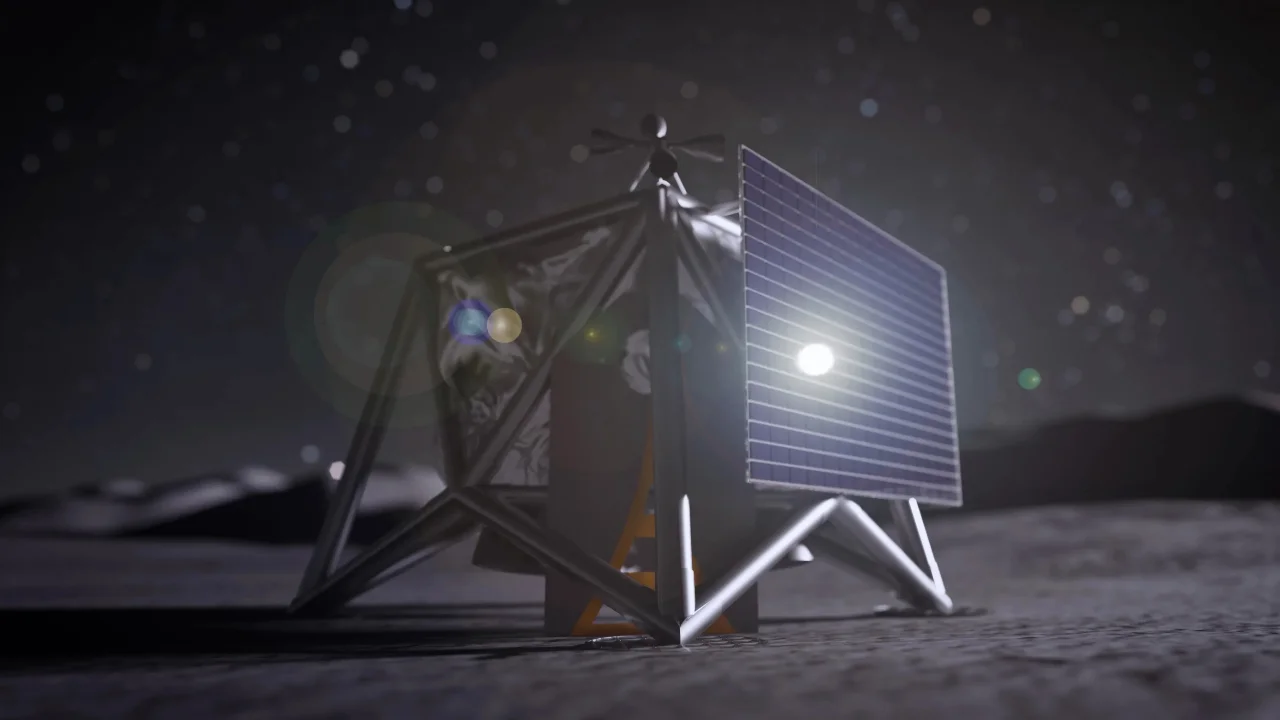
Drawing of a drone in NASA's MoonFall program that will research the South Pole NASA NASA has released details of robotic landing modules, drones, and vehicles it intends to send to the Moon as part of US plans to build a lunar base. Space company Blue Origin, founded by Amazon's Jeff Bezos, is one of several companies chosen to build the machines. The US wants to land Americans back on the Moon before President Donald Trump leaves office in 2029. But NASA is competing with China to put humans on the lunar surface, meaning the space agency is under pressure to look like it is winning the new space race. China is pushing ahead with its own plans to land humans on the Moon by 2030. On Monday (03/25), the Chinese launched their Shenzhou-23 spacecraft, sending a team of astronauts to the country's Tiangong space station. In March, NASA announced a $20 billion program to build a permanent nuclear- and solar-powered base at the Moon's south pole by 2032. NASA Administrator Jared Isaacman said on Tuesday (05/26) that the announcements mean the US will "never give up the Moon again." A base would allow the US to conduct scientific experiments, potentially explore valuable resources, and travel to Mars more easily. Now on g1 But most experts agree that NASA's timeline is unrealistic.
Despite the US success in sending four astronauts around the Moon on its Artemis 2 mission in April, some scientists believe China is likely to be the next country to put humans on the lunar surface. "I wouldn't be surprised at all if China got there first," Simeon Barber, a lunar scientist at the Open University, told the BBC, citing NASA's setbacks in securing a spacecraft capable of landing humans on the Moon. NASA's Ignition Moon Base program has three phases. Before humans travel there, the space agency wants to send robotic landers and drones to explore and map the Moon's challenging terrain. Transport vehicles would also be brought along, capable of carrying astronauts across the lunar surface and hauling scientific and communication instruments. On Tuesday, NASA said companies like Blue Origin, Intuitive Machines, and Astrobotic have been contracted to build the machines. NASA published artistic renderings of a lunar base featuring housing, power systems, and robotic vehicles NASA NASA wants Blue Origin's lunar lander, called Endurance, to be capable of precision landings, as well as autonomous navigation and control. Astrobotic's Griffin-1 lander is expected to touch down in the Nobile crater, near the South Pole. The machines will also provide scientific instruments to NASA, including high-resolution cameras and tools using reflected laser light to help the spacecraft land. This robotic exploration is expected to last until 2029, with 25 launches and 4 tons of cargo landed on the Moon, Carlos García-Galán, Moon Base program executive, said on Tuesday. Next, NASA wants to build nuclear and solar power facilities on the Moon, including fission reactors. By 2032, the space agency wants humans to be able to live on the Moon in “semi-permanent” habitats. Vehicles would also allow astronauts to travel long distances across the rocky surface. The Moon's South Pole is particularly attractive because frozen water could be used for consumption or to produce oxygen. However, NASA's plans depend on preparing a spacecraft capable of safely transporting humans to the Moon. Elon Musk's company, SpaceX, was contracted to build a spacecraft called the Starship Human Landing System, but it has faced multiple setbacks and delays. “The most critical step is getting astronauts onto the surface,” explains lunar scientist Simeon Barber. “It seems to me that [NASA] feels it is in a position where it has to start saying it has plans. So, I think there is a lot of political will behind this,” he says. We used artificial intelligence to translate this report, originally written in English.
The text was reviewed by a BBC journalist prior to publication. Learn more here about how the BBC is using artificial intelligence (link in English).






Sign in to comment on this article.
No approved comments yet.