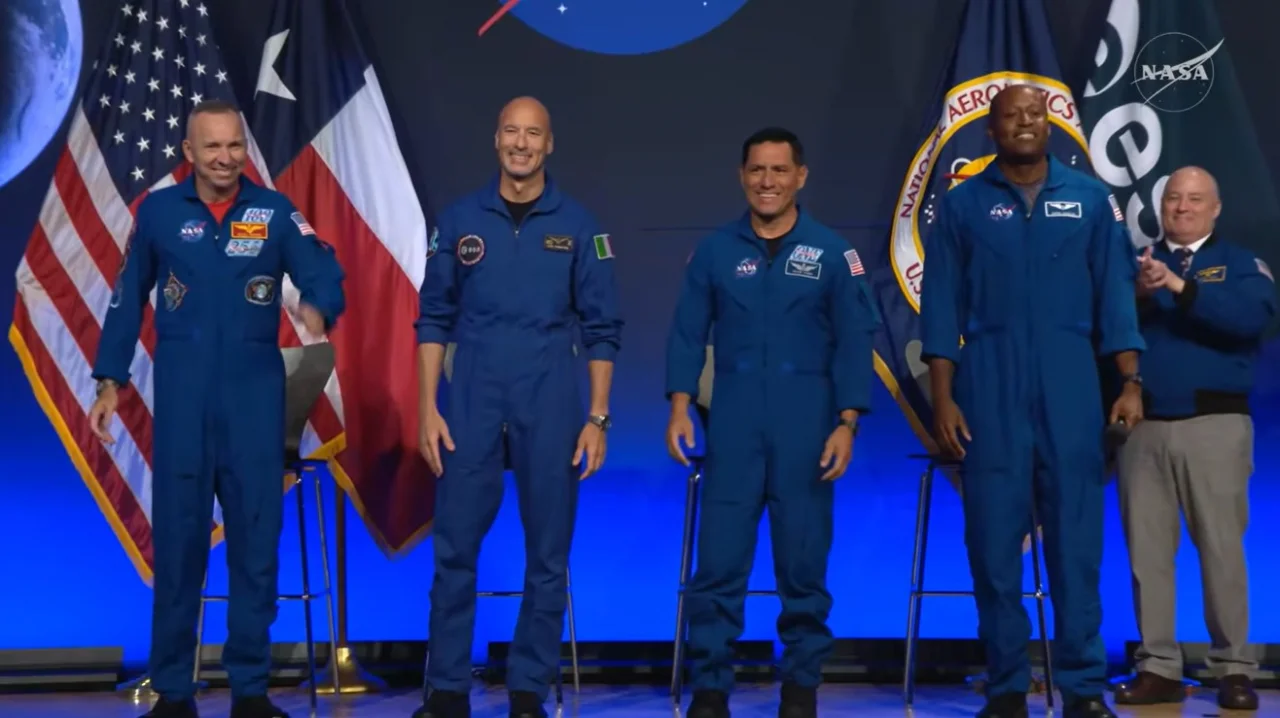
Artemis III crew. In order from left to right: Randy Bresnik, Luca Parmitano, Frank Rubio, and Andre Douglas. NASA NASA announced this Tuesday (8) the crew members for the Artemis III mission, scheduled for 2027.
The four selected astronauts are: Andre Douglas Frank Rubio Luca Parmitano Randy Bresnik See profiles of the mission members below. 🚀Artemis III will test rendezvous and docking capabilities between Orion and commercial human landing systems, necessary to take astronauts to the lunar surface. "Since we added the Artemis III test flight ahead of our first crewed landing on the Moon, our team has been focused on developing the mission to test as much as possible," detailed Artemis lead Jeremy Parsons. It is another step in the process of establishing a permanent base on the Moon, which is only expected to be completed by 2032. (see more details below) Who will the Artemis III crew members be The Artemis III mission will feature four crew members: Andre Douglas NASA astronaut Andre Douglas. NASA. Andre Douglas was selected by NASA to join the 2021 astronaut candidate class.
He began his activities in January 2022. With a degree in mechanical engineering, this will be his first mission with NASA. Frank Rubio NASA astronaut Frank Rubio. NASA A NASA member since 2017, Frank Rubio is a Florida native and holds a doctorate in medicine.
He participated in a 2022 mission to the International Space Station. The crew landed on September 27, 2023, with Rubio breaking the record for the longest space flight by an American astronaut, with a 371-day mission.
Luca Parmitano Luca Parmitano. ESA Italian astronaut Luca Parmitano is the only member of the European Space Agency (ESA) on the mission. He has been part of the agency since 2009 and will be the pilot for Artemis III. In 2011, he was assigned as flight engineer for the Italian Space Agency's first long-duration mission to the International Space Station. Randy Bresnik NASA astronaut Randy Bresnik. NASA Bresnik was selected as an astronaut in 2004 and, from 2009 to 2011, served as a support astronaut on the Space Shuttle program closeout crew. Between 2012 and 2015, he led NASA's partnership with SpaceX on the design and development of the Dragon crew capsule, as well as serving as capsule communicator (CAPCOM) in the Mission Control Center. Planning for the lunar base NASA detailed plans at the end of May for the construction of a permanent base on the Moon.
In announcing the news, NASA Administrator Jared Isaacman highlighted the difficulties of the process and the installation of a base on the Moon, citing extreme weather, radiation exposure, and rugged terrain. "The Moon base is as beautiful as it is hostile," he stated. Isaacman detailed the first three missions planned for as early as 2026. The central objective is to deepen NASA's knowledge of the Moon: Moon Base I: aims to take scientific equipment to the lunar South Pole region and reduce risks for future astronaut explorers.
Scheduled for the second half of 2026. Moon Base II: mission will feature the largest payload ever delivered to the lunar surface, with over 500kg of cargo at once. It aims to mature the capabilities needed to support the payload of a future lunar rover. Moon Base III: will expand knowledge of the lunar surface, in addition to carrying payloads chosen through open competition, as well as by international partners.
The idea is to understand how a future structure on the Moon can perform under extreme weather and terrain conditions. Moon Base I and III missions are also expected to take place before the end of 2026. "These are the first of more than a dozen missions to be announced with the goal of returning to the Moon and building the lunar base," he explained. Exploration Systems Development Mission Directorate Associate Administrator Lori Glaze highlighted the importance of the Artemis II lunar flyby mission in the process of setting up the future lunar base. (review below) READ MORE: 'Chills': Artemis astronauts still feel effects of passing by the Moon What is the far side of the Moon and why is it important to study it Phases for base installation NASA also detailed the stages planned for the installation of the lunar base.
In general, the process will be divided into three major phases: Phase 1: construction, testing, and learning Beginning as early as 2026 and running through 2029. During this period, the first crewed mission is to take place.
It is expected to feature 25 launches and 21 landings. Phase 2: infrastructure establishment With semi-annual crewed missions, this stage is expected to last from 2029 to 2032. This is when the primary infrastructure on the Moon is scheduled to be built. Phase 3: sustained human presence Starting in 2032, the idea is to have a permanent establishment and constant presence of the agency's astronauts on the Moon. Lunar flyby on Artemis II Artemis II begins return to Earth NASA/Reproduction Artemis II, launched in April 2026, was the first crewed mission to the Moon since the end of the Apollo program in 1972.
However, the mission only performed a flyby and did not land on the satellite. ➡️Unlike the Apollo missions, the objective was to test all systems necessary for future missions: the Orion capsule, the Space Launch System (SLS) rocket, and safety protocols for deep space crewed flights. The idea was to pave the way for the Artemis III lunar landing, which, also according to Isaacman, is scheduled for 2027. Cancellation of the orbital space station In March, NASA had announced the cancellation of plans to deploy a space station in lunar orbit. The agency chose to reallocate resources to build a $20 billion base on the lunar surface over the next seven years. "It should come as no surprise to anyone that we are pausing Gateway in its current form and focusing on infrastructure that supports sustained operations on the lunar surface," Isaacman said at the time. The Lunar Gateway station was designed to be a space station parked in lunar orbit.
Repurposing the spacecraft for a lunar surface base is not simple. "Despite some of the real hardware and schedule challenges, we can repurpose equipment and international partner commitments to support surface and other program objectives," Isaacman said. The Lunar Gateway was designed to serve both as a research platform and as a transfer station that astronauts would use to board lunar landers before descending to the lunar surface. Asteroid 2024 YR4 will no longer hit the Moon in 2032, new NASA calculations show.






Sign in to comment on this article.
No approved comments yet.