PR's audiovisual industry moves the economy by projecting the state's stories to the world
The Paraná native Ana Beatriz Fortes never imagined that one day she would see her own life portrayed in the cinema. At 75, while watching the film "Entrelinhas", her heart beat faster as she revisited the period when she was imprisoned and tortured by mistake during the dictatorship.
In the feature film, the character Beatriz, inspired by Fortes, is accused of being involved with subversive student movements and a guerrilla group during the period of repression. The young woman undergoes torture and violent interrogations to admit participation in the organizations, even though she was not part of them.
The production, with Paraná DNA, is just one of several that make up an ecosystem that helps tell the story of Paraná and, consequently, boosts the state's economy through the seventh art.
✅ Follow the g1 PR channel on WhatsApp
Watching the film, for Ana Beatriz, was a kind of "catharsis", a "reckoning" with traumatic feelings that had haunted her for more than 55 years, as she describes.
"Each region of our immense Brazilian territory has its own particularities and characteristics that deserve to be observed and translated into art. In my case, which tells a sad event in our history, I consider it fundamental that the new generations of Paraná know that shameful and brutal facts committed by the Brazilian Army also occurred here and that they need to be told so that they never happen again", she defends.
Ana Beatriz Fortes' story was portrayed in 'Entrelinhas'
GP7 Cinema
Like Entrelinhas, 67 films from Paraná were released commercially between 2009 and 2025. Together, these works reached an audience of more than 219,000 spectators and generated revenue of R$ 2.22 million at the box office, according to a study carried out by the Brazilian Micro and Small Business Support Service (Sebrae/PR) in partnership with the State Secretariat of Culture of Paraná (SEEC).
Among the works produced in the state during this period, fiction films stood out, with 42 films. They were followed by documentaries, with 23 works, and animations, with two productions.
In general, these works have one thing in common: they speak and show Paraná in some way, but they connect with larger subjects, which allows them to be appreciated also by people from outside the state.
Released in 2026, "Meu Avô Stanislau" represents this logic. By following the story of a young man who is sent to spend a few days in the interior of Paraná with his grandfather, who is a leader of a Ukrainian community, the viewer sees landscapes and customs of Paraná.
However, anyone can identify with it as the film reveals the clash between the digital world and traditions, giving rise to a story about family relationships, belonging, and connection.
"The challenge was to understand how to be national and, at the same time, regional. And so, we here at RPC used all the knowledge we have of the people of Paraná to – together with the people from [production company] GP7 – manage to represent our state well in a production shown to the whole country. We dealt with a subject that is universal, like the multi-generational relationship between grandfather and grandson, in an affectionate way, as is normal in our small towns. And with landscapes and elements that at all times refer to the interior of Paraná. A mix that was a great success", describes Marcelo Dias Lopes, Programming Director at RPC.
Both "Entrelinhas" and "Meu Avô Stanislau", according to Guto Pasko, director of both films, show that the state of Paraná has a structured productive capacity, which opens new opportunities for the audiovisual sector in the region.
"Every film that is produced here is taking the image, culture, and history of the state of Paraná, not only to Brazil but also abroad [...]. The people of Paraná want to see themselves. Brazilians want to see themselves on the screen. We just need to have opportunities", says Guto.
Audiovisual industry in Paraná moves the economy and creates jobs
SETI
A Paraná for every story
The strength and productivity of the audiovisual industry in Paraná also attract market institutions and clients from other places.
Luiz Gustavo Vilela, executive secretary of the PrFilm Commission, points out that this interest comes from technical qualities of infrastructure for this approach, such as, for example, good courses and universities with training focused on audiovisual and adjacent areas, a park of structured airports, and relative proximity to São Paulo and Rio de Janeiro, with reduced costs.
Recording in the historic center of Lapa for the film by Maurício de Sousa, creator of Turma da Mônica, in 2022
Miguel Eduardo Dawagi dos Santos
In addition, according to Vilela, the state has the advantage of natural and urban landscape variety, which can fit into several different proposals.
"There is no other state in Brazil that will gather all these characteristics. From an urban point of view, it is very interesting, because the cities have different waves of urbanization over the last 300 years. We have modernism, we have brutalism, we have classic buildings... We can emulate practically all of Latin America", he details.
The executive secretary assesses that the variety and technical qualification transform Paraná into fertile ground to attract productions, investments, and, also, to tell its own stories.
In this sense, five cities stand out as the main regional hubs of the audiovisual sector in Paraná: Curitiba, Londrina, Maringá, Ponta Grossa, and Foz do Iguaçu.
Cities stand out as the main regional hubs of the audiovisual sector in Paraná
Fabio Furtado/RPC
READ MORE ABOUT CINEMA IN PARANÁ:
Historic center of Lapa becomes a setting for a film about Maurício de Sousa
Closing of airspace and village built from scratch: discover behind-the-scenes of a film shot in Paraná
In Curitiba, Coppola was a gatecrasher at a 15th birthday party, tasted 'carne de onça', watched an Athletico game, and gave a lecture to students
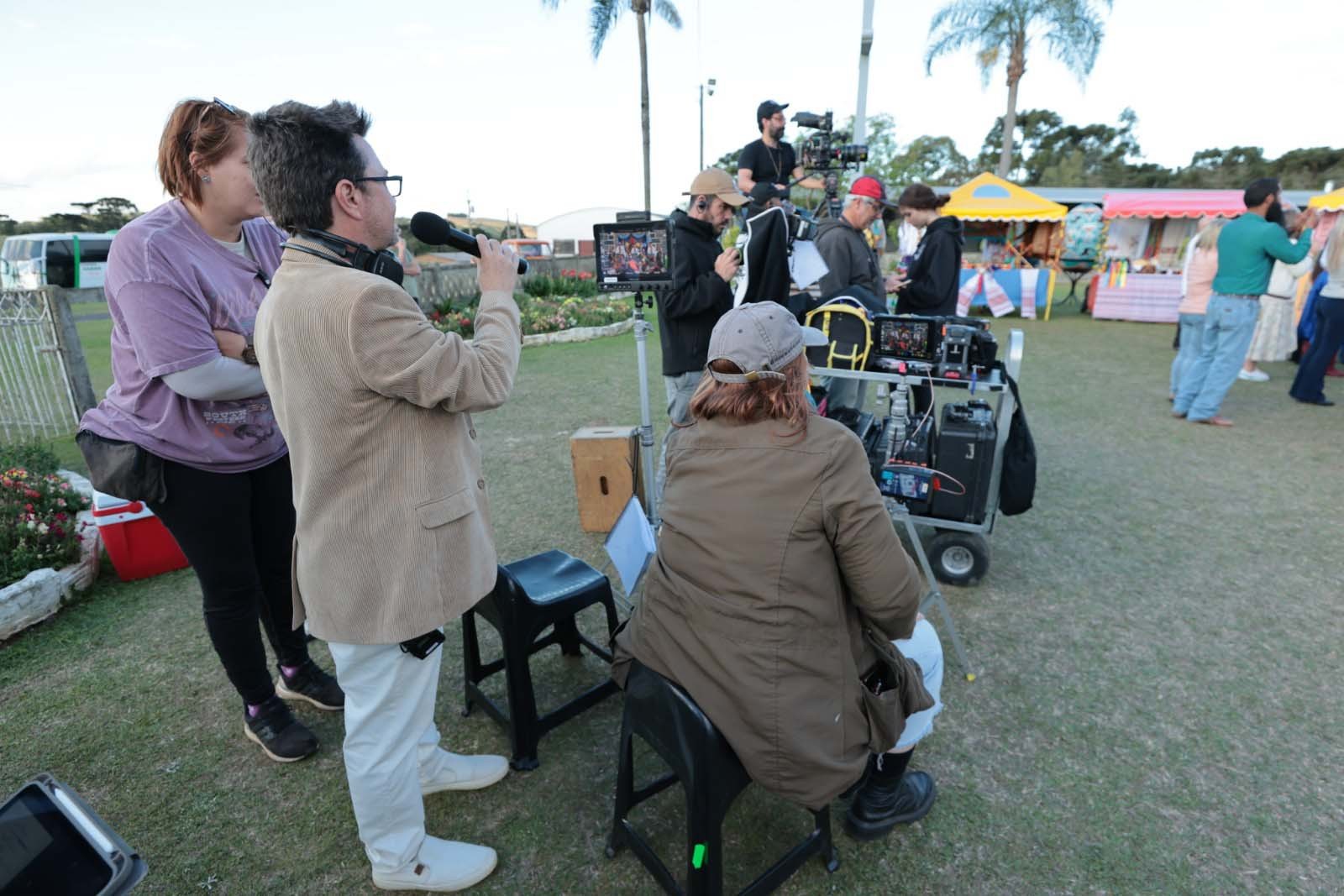
It takes a crowd for a film to be born
In Paraná, 29.3% of companies registered in the audiovisual sector have at least one employee hired under the CLT regime. But, according to Luiz Gustavo Vilela, executive secretary of the PrFilm Commission, in most productions, most of the labor is hired on a temporary basis.
He highlights that, in works made in the state, production companies prioritize professionals from Paraná.
This was the case of the film “Nova Éden”, by director Aly Muritiba. The recording of the film, shot essentially in Paraná, directly involved about 150 people. Also considering suppliers, the number of people involved exceeds 300.
In a large production like this, the work begins long before the shooting of the recordings and goes far beyond the end of them. The functions range from the person who does the research to select options for the film's locations to the person who takes the actors from one side to the other on the set.
Aly Muritiba, director of Nova Éden
Mariah Colombo/g1
The audiovisual production chain consists of six stages: development (or planning), pre-production, production, post-production, distribution, and exhibition.
When a film is made in Paraná, the impact on the local economy is considerable. Nova Éden alone moved at least R$ 15 million in the economy of Paraná. The values are reflected beyond the audiovisual market, according to the director.
"It's job creation, income creation, money circulation in the economy. Not just in the cultural economy. With a production of this size, you rent vans, tents, stalls, food service, accommodation, gas stations. You make money circulate", defends Muritiba.
A report by the specialized consultancy Olsberg SPI, made in 2020, found that global audiovisual spending in 2019 was estimated at US$ 177 billion, but, when indirect and induced effects were considered, the total economic impact reached US$ 414 billion.
This occurs because, for every dollar invested directly in the sector, more than two additional dollars are generated in different areas of the economy, according to the report. In 2024, it is estimated that global audiovisual spending reached US$ 247 billion.
Making-of of the recordings of the film Nova Éden, by director Aly Muritiba
Leticia Futata/Disclosure/Olhar Filmes
An expanding market
The growth of the industry in the state has even led people from outside the area to seek roles in the audiovisual sector.
This is the case of Ales de Lara, who has a degree in Biology. She left her career as a teacher and, little by little, her affinity for cinema led her to dedicate herself to the audiovisual sector, which is now her main job.
Ales is a director of horror short films, a screenwriter, a character makeup artist, and does practical special effects. For her, the experience with Biology still contributes, with a different look, to the work in cinema.
"Makeup and special effects require knowledge of anatomy. Knowledge that I have thanks to biology. When we talk about blood, we need to understand the difference between arterial blood and venous blood. When we talk about wounds, we need to understand the healing time and the transformations that happen to them over time. [...] You need to understand these transformations to make the makeup believable", she exemplifies.
After the radical career change, Ales sought to deepen her knowledge in the new area, did a postgraduate degree in Cinema, and other specialization courses.
Paraná has 35 undergraduate courses, including bachelor's and technological degrees, focused on the audiovisual sector. Of these, only three are offered by public higher education institutions and only two are free.
According to Sebrae, 57.4% of professionals working in the area have education up to the high school level, 29.5% have a higher education degree, and 10.4% have only elementary school education.
From an old case, the national reference
Paraná's expertise in the audiovisual sector is nothing new. It was in 1897, at the old Theatro Hauer, that the artistic variety company Faure Nicolay presented a moving image show for the first time.
Born there, a few years after the pioneering presentation of the Lumière brothers in Paris, in December 1895, was the state's relationship with the seventh art.
According to the Museum of Image and Sound (MIS), until the 1930s, three people from Curitiba made genuinely Paraná works: Annibal Requião (1875-1929), João Baptista Groff (1897-1970), and Arthur Rogge.
Since then, the local audiovisual sector has gone through several phases and experimented with different styles. Along the way, in 1975, the Cinemateca de Curitiba was founded.
Cinemateca de Curitiba was founded in 1975
Curitiba City Hall/Disclosure
The development of the area was consolidated to the point that, today, Paraná is on the map of world cinema.
In this context, since 2012, the state has hosted one of the largest film festivals in Brazil: Olhar de Cinema.
The event's program features more than 80 films. Part of them is shown in the Mostra Mirada Paranaense, reserved to present to the public an overview of local audiovisual production.
"From the first minute of the Festival, this has always been a showcase that was with us, because we strongly believed that a festival needs to be connected with the place where it is, with its community, precisely because we strongly believed in this potential of a festival to boost films", details Antonio Gonçalves Junior, creator and director of Olhar de Cinema, who also highlights how the showcase has revealed talents over the years.
The festival is not limited to local connection and care with curation. Consolidated as one of the main events in the sector in the country, Olhar de Cinema has the Independent Cinema Market (MECI), considered a space for meetings, business, and training aimed at Brazilian and international audiovisual professionals.
Through panels, masterclasses, pitchings, case studies, and networking sessions, the Independent Cinema Market connects the agents of the audiovisual production chain.
"MECI came to take a new leap in this direction of enabling and boosting the connection of people, always thinking about the market issue, stimulating co-productions, sales, connections... Films have the artistic part, but they are also products that can be monetized, that can generate revenue, that can generate jobs, that can generate income", he defends.
Olhar de Cinema was born in Paraná and is one of the largest film festivals in Brazil
Tip Mídia
On the other side of the big screen
Despite the audiovisual growth in the state and the effort for the people of Paraná to see themselves on the big screens, the number of cinemas in the state goes against this.
According to data from the National Cinema Agency (Ancine), in all of Paraná, only 34 cities have movie theaters, which represents 8.5% of the state. If residents of the 365 other municipalities want to see a movie in the cinema, they need to travel to other cities – often facing long distances.
Among the cities in Paraná, Curitiba is the one that most concentrates cultural spaces dedicated to showing films. The state capital currently has 21 cinema complexes in operation, with a total of 95 screening rooms, according to Ancine.
In 2024, the audience in Curitiba's movie theaters totaled 3.21 million spectators, with the screening of 392 titles. This represents an increase of 170,638 people compared to 2023, or 5.6%. In 2019, the total audience was 4.2 million, which represents a drop of 24.1% by 2024.
Among the audience in Curitiba's movie theaters, 92% watched foreign works, while only 8% saw national productions. The low demand from the public for these films still represents a challenge for the local industry.
"National cinema has its own strength, its own language characteristics, and the public needs to learn how to deal with it, to decode this. One way is the production of films that are, in fact, interesting for people to see. We don't want people to go see national cinema just to honor it. I will watch national cinema because I am interested, because I want to know these stories", defends Luiz Gustavo Vilela.
In all of Paraná, only 34 cities have movie theaters, according to Ancine
Disclosure/Limeira Shopping
The screen quota for national films, which requires movie theaters in Brazil to reserve a minimum proportion of annual sessions for Brazilian productions, is pointed out as one of the possible ways to reduce this distance.
In Paraná, initiatives linked to the state government were responsible for bringing cinema entertainment and providing access to culture for free to spectators in interior municipalities that do not have commercial screening rooms.
Cinema na Praça, for example, showed films in 144 municipalities in the state in 2024.
The strengthening of decentralization, added to the creation of a circuit of public movie theaters, are possible ways to circumvent this challenge. In the city of Curitiba, Cine Passeio has sessions of Brazilian and international films, selected by specialized curation. According to the city hall, about 600 people pass through the space daily.
The cultural complex, inaugurated in 2019, occupies a historic building. The operation of the space at the location helped to revitalize the occupation in the center of the capital of Paraná.
With the same administration and curation, Cine Guarani is another cinema of the Curitiba City Hall, and is located outside the central region, near the Portão neighborhood terminal.
In the assessment of Luiz Gustavo Vilela, the key to bringing the public closer to national productions lies in building a bond of recognition and belonging with what is shown on the screens.
"It is necessary that both the films find the public and the public manages to find this cinema [...] The people of Paraná need to learn to see themselves, we need to hear our accent", he concludes.
Cine Passeio offers film sessions in two screening rooms, resuming the culture of street cinemas in Curitiba
Giuliano Gomes/PRPress
VIDEOS: Most watched on g1 Paraná
,
Read more news on g1 Paraná.
Expanding, Paraná's audiovisual industry moves the economy and creates jobs by projecting the state's stories and landscapes to the world
PR's audiovisual industry moves the economy by projecting the state's stories to the world. Paraná native Ana Beatriz Fortes never imagined that one day she would see her own life portrayed in the cinema. At 75, while watching the film "Entrelinhas", the...



Sign in to comment on this article.
No approved comments yet.