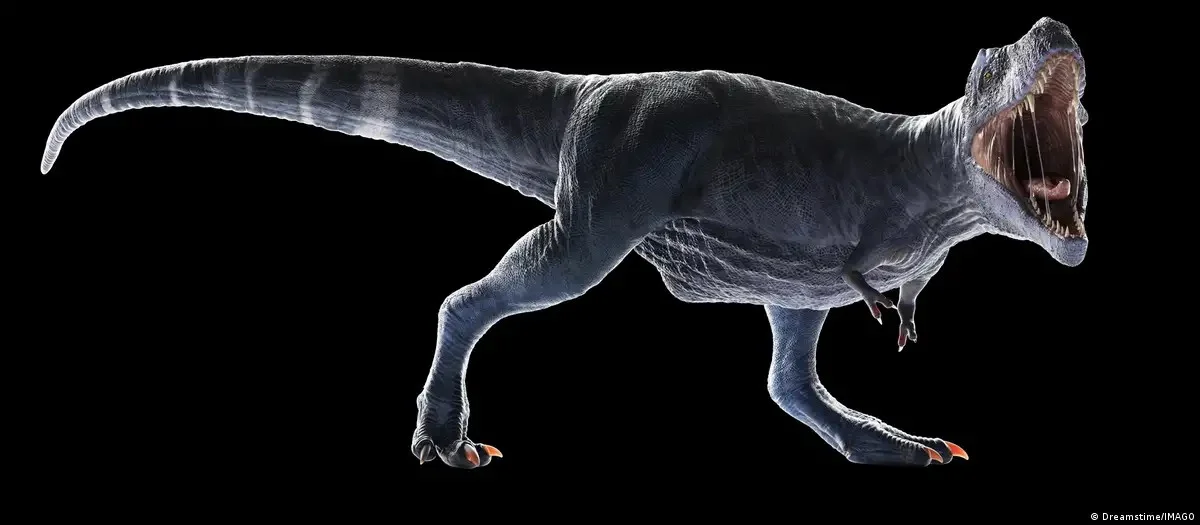
The T-Rex would have developed extremely powerful jaws as its arms shrank through evolution Dreamstime/IMAGO The T-Rex is famous for two seemingly contradictory things: it was one of the most fearsome predators that ever walked the Earth and, at the same time, had tiny arms that seemed like an evolutionary joke. Now, a new study led by researchers from University College London (UCL) and the University of Cambridge offers new evidence in favor of a long-debated hypothesis: these predators became increasingly dependent on the strength of their jaws to capture and subdue their prey, while their forelimbs simply became less relevant and gradually diminished throughout evolution. Five lineages and one same evolutionary solution The research, published in the scientific journal Proceedings of the Royal Society B, analyzed data from 85 theropod species – bipedal dinosaurs, mostly carnivorous – and found evidence that the shortening of arms emerged independently in at least five distinct groups: tyrannosaurs, abelisaurids, carcharodontosaurids, megalosaurids, and ceratosaurs. Although they belonged to different evolutionary branches and lived in very different eras and regions, they all developed remarkably reduced forelimbs, albeit through diverse anatomical processes. Now on g1 "Carnotaurus had ridiculously small arms, even smaller than those of the T-Rex," said Charlie Scherer, lead author and doctoral student at UCL. Five groups of theropods independently developed tiny forelimbs Chase Stone/REUTERS Lethal jaws, diminutive arms The analysis revealed that dinosaurs with stronger skulls and more powerful jaws also tended to develop smaller arms. To analyze this relationship, the researchers developed a method capable of assessing skull robustness using various anatomical factors, such as head shape, bone joint resistance, and estimated bite force. According to the study, the T-Rex scored the highest, followed by Tyrannotitan, a theropod of similar size that lived in what is today Argentina, more than 30 million years ago. This correlation held true regardless of body size.
Majungasaurus, a predator from Madagascar that lived 70 million years ago, weighed only 1,6 ton – one-fifth the weight of the T-Rex – and exhibited the same pattern of robust head and tiny arms. What led to these animals' dependence on their jaws? The answer, according to the researchers, likely lies in the size of their prey. The same ecosystems where these large predators emerged also housed gigantic sauropods, long-necked herbivores that reached enormous dimensions. Facing animals of this size would have favored the use of jaws capable of biting and gripping with tremendous force, while the front claws gradually lost their utility as the primary hunting tool. "Trying to pull and grab a sauropod of 30 meters with claws is not ideal.
Attacking with the jaws may have been more effective," explained Scherer. The "Majungasaurus" of Madagascar exhibited the same pattern of robust head and small arms as the T-Rex Dreamstime/IMAGO A possible explanation is that maintaining both a large head and large forelimbs simultaneously could imply a high energetic cost. "It is a classic case of 'use it or lose it'," summarized the researcher.
Over time, "the head replaced the arms as the primary method of attack." Not all theropods followed the same path Of course, not all large theropods followed this same evolutionary route. Spinosaurus and megaraptorans maintained long and relatively well-developed arms, combined with narrower skulls.
And although the T-Rex's arms might seem absurdly small from a modern perspective, they were probably not completely useless. Some previous estimates suggest they could still lift more than 100 kilograms, so it is possible they continued to perform secondary functions.






Sign in to comment on this article.
No approved comments yet.