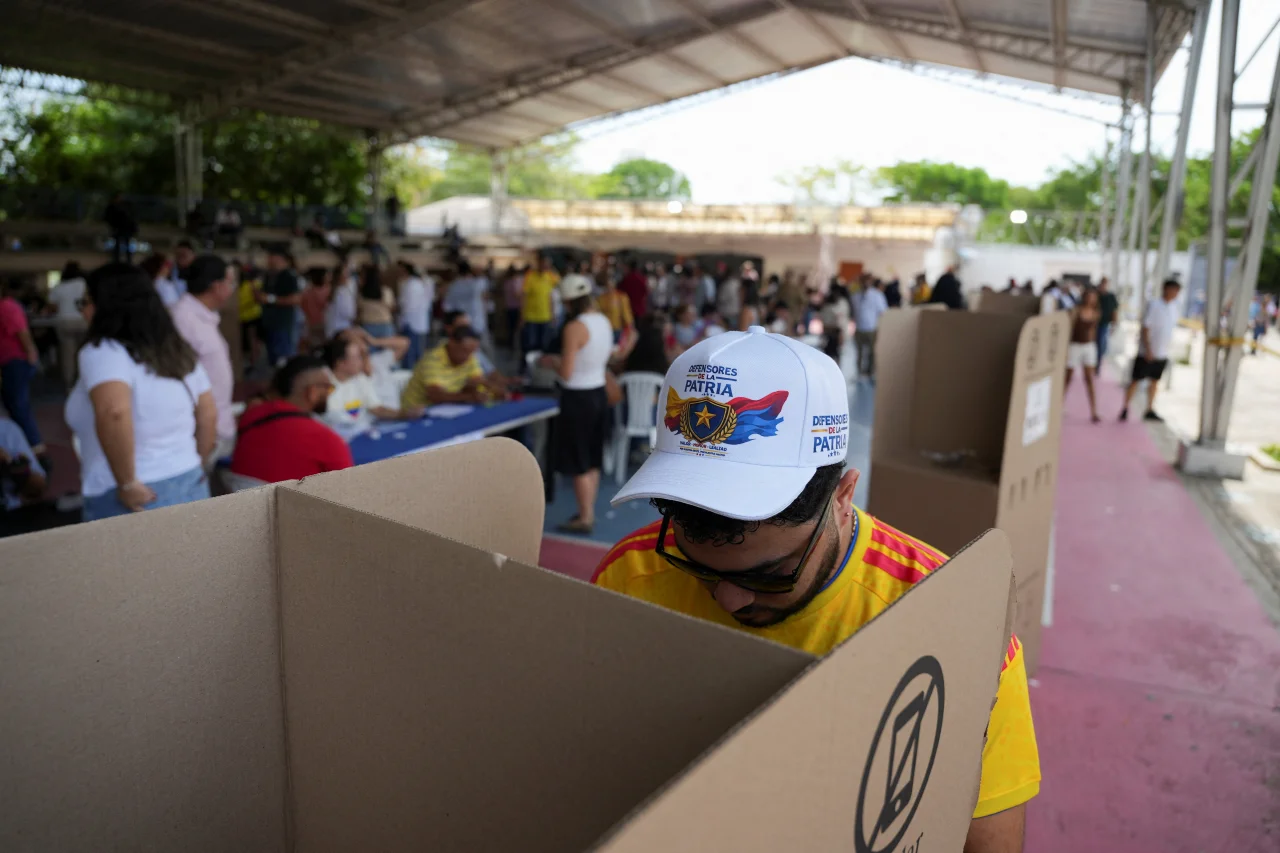
Supporter of Abelardo de la Espriella votes during the 2nd round of presidential elections, in Barranquilla, Colombia, on June 21, 2026. Jair Coll/ Reuters The preliminary result of the elections in Colombia pointed to businessman and lawyer Abelardo de la Espriella as the winner, with about 250,000 votes ahead of Senator Iván Cepeda Castro. The first phase of the count took place on Sunday (21), after the second round of voting. In the Colombian election, the count has two stages.
The first is the so-called preconteo, a preliminary count made from the minutes of the polling stations. But, according to the country's legislation, the official result is only proclaimed after the scrutiny, in which judges and other authorities review the minutes to correct any inconsistencies. What is scrutiny? Scrutiny is the official, definitive count with legal validity, which begins immediately after the end of the preconteo and can last for days. In this phase, the process leaves the hands of the polling station jurors and passes to scrutiny commissions, composed mainly of judges, notaries, and other electoral delegates. 🔎The preconteo is the quick and provisional count of votes released on election night in Colombia, held immediately after the polls close. The polling station jurors manually count the paper ballots, fill out a physical minute, and transmit the data by phone to the electoral center, which updates the results in real-time for the public and the press. 🔎Because it is susceptible to typing errors and erasures, this process has an exclusively informative character and has no legal value to declare or certify the winning candidate. In the scrutiny, the commissions check the original physical forms sent from each station. Representatives and inspectors from all campaigns accompany the check in person. If there is a mathematical inconsistency, erasure, or suspicion of fraud in the minute, the parties can demand the opening of the ballot box and the physical recount of the paper votes. The official result is only consolidated and the winner officially declared when the National Electoral Council (CNE), in Bogotá, consolidates the scrutiny of the entire country and judges all appeals and challenges presented by the campaigns. In tight races, this verification usually takes about a week. Far-right candidate wins election in Colombia, preliminary count shows How do elections work in Colombia? Presidential elections in Colombia occur every four years and work in a system of up to two rounds. If no candidate reaches more than 50% of the valid votes in the first round (held at the end of May), the two most voted candidates dispute the second round three weeks later, in June. The vote is entirely on paper ballots deposited in physical ballot boxes. The president-elect serves a single term. Re-election is prohibited by the Constitution. On the ballot, the electorate has a wide range of options because of the country's political fragmentation, which has dozens of registered parties. In addition to traditional acronyms, Colombian law allows candidacies by "Significant Groups of Citizens" (independent movements that collect signatures). In the first round of 2026, for example, 9 candidates ran for the Presidency representing left, center, and right alliances. The voting days, which always happen on Sundays, the polling stations operate in a short period, opening at 8 AM and closing mandatorily at 4 PM (local time). To ensure security, the government activates the Armed Forces to patrol the polling stations and decrees strict measures. Traditionally, the government adopts measures such as the temporary closure of land borders and the so-called 'dry law', which prohibits the sale and consumption of alcoholic beverages from the eve until the morning after the voting. Supporters of candidate Iván Cepeda heading to a rally after the release of preliminary results. Sergio Acero / Reuters Right vs left in the 2nd round of the Colombian election The 2026 election became a "tug-of-war" between the country's current president, Gustavo Petro, and US President Donald Trump. Cepeda was the candidate supported by Petro, while the ultra-rightist Espriella had declared support from the North American leader. Read more below. The election result would cement the wave of right-wing governments in Latin America. This is because Espriella can join several Latin American countries that have elected right-wing governments in recent years, such as in Chile, with Jorge Kast, and Bolivia, with Rodrigo Paz. The CNE said that the voting took place peacefully and without major incidents, and with international observers, such as representatives of the OAS and the European Union. After controversy in the 1st round, Petro stated this Sunday after voting that he will respect the election result. Even so, the current president made several requests for a mobilization of the population to monitor the electoral minutes. Cepeda also said he will respect the verdict, but spoke of doing a "very clear, rigorous, and thorough supervision" of the count. Abelardo de la Espriella and Iván Cepeda Reuters/Luisa Gonzalez; Reuters/Sergio Acero After the end of the voting, Espriella stated in a video on social media that he wants to be remembered as "the reconstructor of the fatherland". Espriella, a 47-year-old lawyer and businessman with no political experience, presents himself as an "anti-establishment savior" and repeats campaign promises of far-right names in Latin America. He won the first round with hardline proposals to combat organized crime, cut government programs and taxes, and revitalize oil exploration. He is also a naturalized US citizen, has lived in Miami, and is a registered Republican. Read more about the projects of the two candidates for Colombia. An admirer of the policies adopted by Trump and the president of El Salvador, Nayib Bukele, the ultra-right candidate promises a military offensive and the construction of 10 mega-prisons. “In my government, there will be no peace processes. Criminals who do not submit will be eliminated, as permitted by law,” stated Espriella. The right-wing candidate's discourse was what resonated most with the electorate in the first round. Opinion polls have been pointing to violence as the main factor of concern among Colombians, ahead of the economy - weakened by the pandemic and the increase in the fiscal deficit, despite the current government increasing the nominal minimum wage by 75% and reducing unemployment. Espriella blames Petro for Colombia's economic and security problems and promised to reduce the size of the State by 40%, expand the tax base, and cut corporate taxes to promote employment in the private sector. “Security was the central issue of this campaign, which led to De La Espriella's victory in the first round,” political analyst Eduardo Pizarro told Reuters. Pizarro states that the perception of insecurity has increased in cities, including concerns about extortion and petty crime. At the same time, the expansion of armed groups in rural areas has affected more civilians. Cepeda had led the voting intention polls before the first round. Therefore, Espriella's victory in the first round was so surprising that Petro even contested the result, later recognized by Iván Cepeda. Fear of contestation and violence in the streets Elections in Colombia: Abelardo de la Espriella (left) and Ivan Cepeda (right) Reuters The contestation increased tensions and fueled fears that the Petro government would claim the results in the event of an Espriella victory. The Electoral Court of Colombia asked this Sunday that all parties respect a result. Authorities fear that the contestation by one of the parties of the results will encourage protests in the streets and increase episodes of violence that occurred during the electoral process. Last year, the right-wing candidate for president, Miguel Uribe, one of the favorites in voting intention polls until then, was assassinated during a rally. Right in Latin America Man holds stickers with images of the two candidates for president in the second round of Colombia, imitating World Cup stickers, on June 4, 2026. Jose Vargas/ Reuters De la Espriella's victory confirms the wave that led other right-wing leaders to victory in Latin America and represents its greatest triumph so far, isolating left-wing governments in the region and redrawing the continent's geopolitical alliances. The result backs a movement that has, among its main representatives, Nayib Bukele, in El Salvador, Javier Milei, in Argentina, and José Antonio Kast, in Chile.





Sign in to comment on this article.
No approved comments yet.