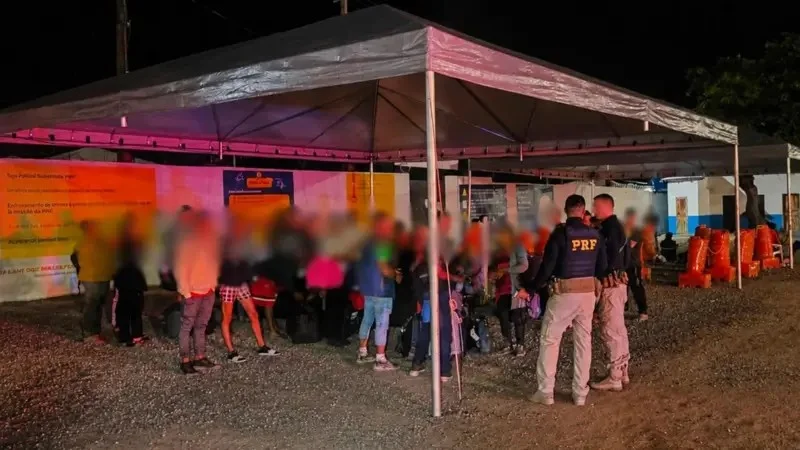
Cubans lead refugee claims in Brazil It was the early hours of a Thursday, June 11, when Federal Highway Police (PRF) officers came across a situation that in recent months has ceased to be a novelty in Roraima: a group of 43 people dragging heavy suitcases walking along the shoulder of the BR-401 highway in Cantá, about 10 kilometers from the capital, Boa Vista. They were children, women, and men who had entered Brazil "secretly" hours earlier across the border with Guyana, a few days after leaving their home country, Cuba. ✅ Follow g1's international news channel on WhatsApp "These are people arriving here in a very degrading situation, some without food, eating only crackers, and suffering from respiratory and gastrointestinal diseases," reports Isaias Magalhães, PRF officer and head of communications in Roraima. Abandoned by an underground network of "coyotes" who smuggled them across the border, the group joined another 13,000 Cubans who applied for asylum in Brazil this year, according to data up to April 2026 from the International Migration Observatory (OBMigra), run by the Ministry of Justice in partnership with the University of Brasília (UnB).
According to Federal Police records of regular foreign entries at air and land border checkpoints, 6,000 Cubans entered the country in 2026. The Ministry of Justice emphasizes that asylum applications do not necessarily correspond to new arrivals in the country, since some applicants may have entered Brazil in previous years and formalized their requests only now.
Still, the difference between the 13,000 asylum requests and the approximately 6,000 regular entry records for Cubans suggests an increase in migration through irregular routes or routes not registered at official immigration posts, something noticed by researchers and shelter organizations in Roraima. Cubans have been rescued on the BR-401 highway in Roraima PFR Read more Ramiro Valdés, revolutionary hero and former vice president of Cuba, dies at 94 Cuba approves major economic opening in nearly 70 years The figures also confirm a turning point that began in 2025, when Cubans surpassed Venezuelans to become the nationality with the most asylum applications in Brazil. Last year, there were about 42,000 Cuban applications, 20,000 more than Venezuelan ones. Since Guyana does not require visas for Cubans, thousands have flown from Havana to the airport in Georgetown, the capital of Guyana, with layovers in countries like the Dominican Republic.
From there, they embark on a journey lasting up to 20 hours by road (mostly unpaved) to Lethem, on the border with Brazil. There, they are smuggled across the Tacutu River by coyotes in a boat.
In Brazil, they board overcrowded cars that speed toward the Boa Vista region, where they apply for asylum to stay in Brazil. These are routes that "expose people to various protection risks, such as unsafe transport conditions, indebtedness, and situations of exploitation," explains Thaisa Freitas, coordinator of the Jesuit Migrant and Refugee Service in Roraima, which has seen a significant increase in assisting Cubans. According to Brazilian law, foreigners arriving in national territory can request recognition as refugees "before any immigration authority at the border." In other words, in theory, Cubans would not need to undergo clandestine crossings. However, according to immigrants and sources who spoke to BBC News Brasil, many Cubans are led to believe they must take this route through irregular smugglers, paying amounts exceeding $10,000 (R$ 51.4 thousand) since leaving Cuba. Professor Marcia Maria de Oliveira, who develops research projects on migrations at the Federal University of Roraima (UFRR) and has been listening to Cuban immigrants, says that correct guidance is not reaching Cuba. "I understand that the information circulating in Cuba is very limited, but I cannot understand how it isn't passed around among them that it is unnecessary to go through these smuggling and human trafficking groups," she explains.
According to the PRF, over the past week, the number of immigrants entering and filing for asylum at the Bonfim border post without subjecting themselves to the clandestine route has started to increase. This is a sign, according to officer Magalhães, that word may be starting to reach Cuba that "Brazil is not like the US" and can welcome migrants at the border. The increase in the arrival of Cubans to Brazil coincides with stricter measures at the US border since the return of the Donald Trump administration in 2025.
It also reflects the closure of a "migration corridor" in Central America for Cubans. In 2021, the Nicaraguan government eliminated the visa requirement for Cubans, allowing thousands to fly legally to Managua. From there, many Cubans leaving the island behind traveled overland through Honduras, Guatemala, and Mexico toward the US border. However, on February 8 of this year, following American pressure, Nicaragua ended visa-free entry for Cuban citizens. One of the few countries that does not require a visa happened to be Guyana. The record also occurs amid a severe economic crisis and the collapse of thermoelectric power plants leading to daily blackouts in the country. The decades-long US economic embargo on Cuba has intensified like never before.
Since the capture of Nicolás Maduro, former president of Venezuela, by the US, Cuba has also lost its largest oil supplier, leading to a widespread shortage crisis in the country. Trump has threatened to impose import tariffs on any country that sends oil to the island. Cuba also faces severe climate challenges, with frequent hurricanes, a motivating factor that Professor Oliveira has also heard in her conversations with migrants. "So, besides not having conditions to keep the lights on day and night, you also have the destruction of all infrastructure," she says.
With an increasingly difficult route to the US and a crisis with no signs of improvement, Cuban eyes have turned to Brazil. Cubans were rescued at dawn walking on a highway in Roraima PRF The saga of a Cuban family to Brazil Evelio Vazques, 45, still remembers his desire to visit Brazil when he turned on the television in the 1990s and saw the tropical setting of Pontal da Areia, the fictional village where twins Ruth and Raquel feuded in *Mulheres de Areia*. "We dreamed of Brazil since childhood because we grew up watching Brazilian soap operas and saw affinities with the country, like people's manners, their empathy," says the Cuban. A psychologist with a doctorate specializing in couple conflicts, Evelio survived in recent years working as a tour guide and driver of the island's famous classic cars, such as the iconic 1959 Ford and 1956 Cadillac. His family's livelihood depended mostly on tips from foreign tourists. "With a psychologist's salary, you couldn't even buy 30 eggs a month.
And even with the money, you could go 20 days without finding any simply because there are no eggs," he reports. The situation in the country deteriorated even further after the COVID-19 pandemic, which heavily hit tourism, one of Cuba's largest sources of revenue. In 2018, the country reached a historic record of 4.7 million visitors, generating $2.782 billion in revenue (about R$ 14.3 billion). In 2025, there were only 1.8 million visitors, according to Cuba's National Office of Statistics and Information (Onei). Following Maduro's capture in January and the blockade ordered by Trump on oil shipments, the island's already fragile economy became even more exposed, deepening an energy crisis that directly affects the daily lives of millions of people. "Cuba today is a country where, even if you receive remittances from abroad, there is nothing to buy; electricity lasts for two hours, and then we go 30, 34 hours straight without power. It's a collapse," says Evelio.
The Cuban then decided to organize his trip to Brazil with his wife and three children, aged 17, 6, and 4—the two youngest being autistic. He sold everything he had, borrowed money from relatives in the US, and bought plane tickets to Guyana. The idea was to work in the neighboring country for a few months to save some money and make the journey to Brazil on his own in a rented car.
However, he ended up being advised to abandon the idea due to perceived risks of not being able to cross the border. "We Cubans are programmed to believe that what is on paper doesn't work. So I was afraid that, being Cuban, I would be left along the way." Professor Marcia Maria de Oliveira reveals that "you won't find a single Cuban who came here without using coyotes." "They reported that it is very difficult to leave the country without going through these clandestine networks." Evelio's family took a van from Georgetown to Lethem, Guyana, a trip that, according to the psychologist, cost $1,250 (R$ 6.4 thousand), five times more than what was charged to other nationalities.
In the border town, a "coyote" was waiting for them. "At a certain point, they told us to get out and led us into a jungle area," reports Evelio, who says he didn't feel afraid. The family crossed the Tacutu River, which separates Lethem and Bonfim in Roraima, by boat after paying an additional $180 (R$ 925). "On the other side, someone told us: 'Congratulations, you are now in Brazil,' and we started walking again along a makeshift path."
According to the PRF, vehicles seized on the roads between Bonfim and Boa Vista usually carry more than double their capacity, an overcrowding faced by Evelio's family. Once in Boa Vista, the family formalized their asylum request, an instrument that requires the migrant to be suffering persecution based on race, religion, nationality, social group, or political opinion, or that their country faces a severe and widespread violation of human rights. Evelio, his wife, and children slept in hammocks hung from trees until they managed to pay for a communal house offered to Cubans in the same situation. After doing odd jobs as a gardener and construction worker, they managed within 10 days to rent a small house in Boa Vista, where they live to this day. The Cuban is grateful for the treatment received from Brazilian institutions, such as the Federal Police, but says there is a gap regarding the welcoming of Cuban migrants. He laments that Operation Acolhida (Welcome Operation), created in 2018 specifically to receive Venezuelans at the Roraima border, was not adapted to now include his nationality. BBC News Brasil asked Operation Acolhida, maintained by the Ministry of Social Defense, and the Ministry of Justice if there are plans for the project to cater to Cuban migrants, but received no response on this point. The Ministry of Justice stated that it "implements the National Policy on Migration, Refuge, and Statelessness, aimed at the integration of these populations in the areas of health, social assistance, education, human rights, and job creation." Evelio and his family have remained in Boa Vista ever since.
Currently, he works as an Uber driver. "I wanted to thank Brazil very much for the respect with which they treat us. We are used to being humiliated, subjugated, or disrespected because of our status," says the Cuban. "But what we want is viable and fast social integration.
We need to be useful with our professions, our workforce, because we want to help Brazil, a country that is welcoming us." In Boa Vista, Evelio joined other Cubans and founded the "Asociación de Comunidades Cubanas en la República Federativa de Brasil," aiming to organize the community and provide accurate information to those wishing to come to the country. Evelio worked for 9 months in Guyana before managing to move to Brazil BBC Brazil just as a transit point According to researcher Marcia Maria de Oliveira, less than half of the Cubans she speaks with in Boa Vista's shelters intend to stay in Brazil.
Most, she says, intend to continue their journey to other Spanish-speaking South American countries, such as Argentina and Uruguay, or to North America. According to Federal Police data, in 2025, 21,000 Cubans officially entered Brazil's borders and 5,400 left through the border of Santana do Livramento, in Rio Grande do Sul, toward Uruguay. Others, the researcher says, plan to apply for asylum in Brazil so that, after three months, they can apply for resettlement in countries like Canada—a mechanism by which recognized refugees can be transferred to a third country that agrees to receive them and offer permanent protection. "Many of these agencies in Cuba, when they sell the package, they already sell it to Canada," Oliveira reports. The Ministry of Justice said in a statement that it "acts to preserve the purpose of the asylum institute, as provided for in Brazilian legislation and international protection instruments." BBC News Brasil asked the embassies of Cuba and Guyana in Brazil about the treatment of migrants and the actions of criminal groups at the border, but received no response by the time this report was published Evelio and his wife live in Boa Vista, Roraima today BBC.






Sign in to comment on this article.
No approved comments yet.