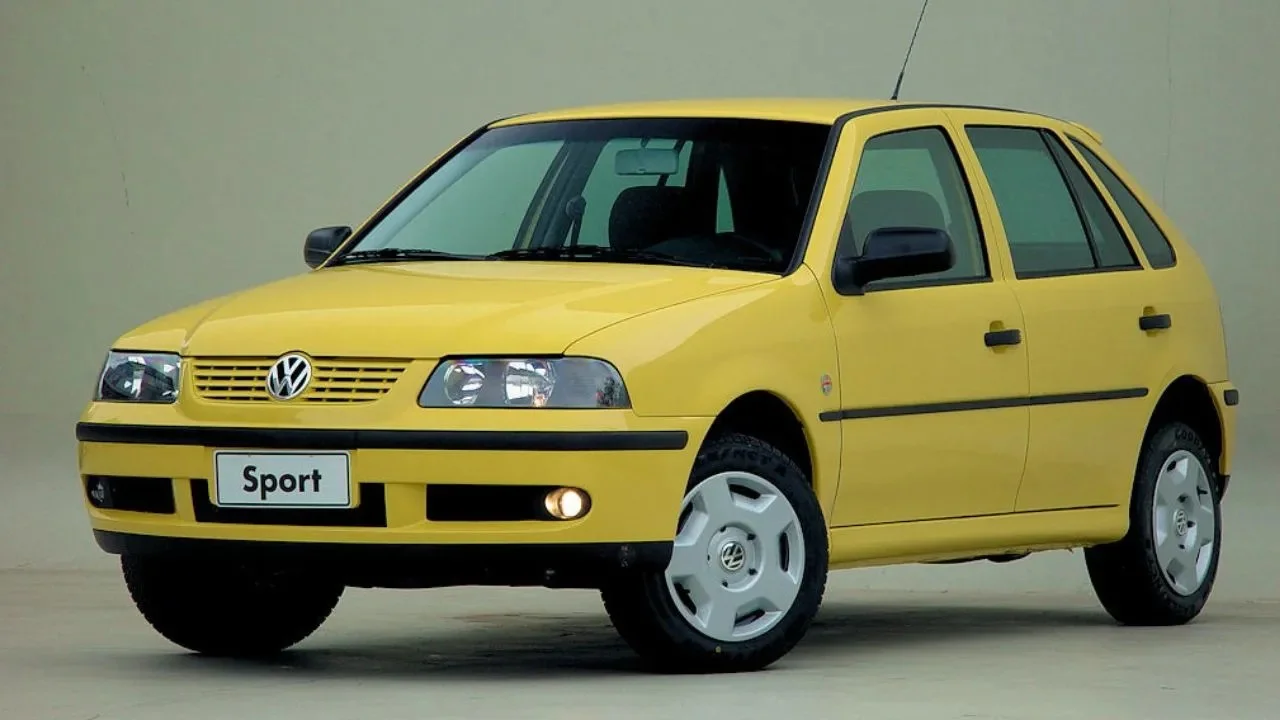
2002 Volkswagen Sport was the model that referenced the World Cup disclosure / Volkswagen Brazilian fans have been living through a 24-year drought without winning the World Cup. Going back to 2002 means remembering good football and also getting a reality check. The Brazil of 2002 did not have social media — Facebook and the now-defunct Orkut would only be created in 2004.
The iPod was still in its infancy and smartphones did not exist. ✅ Click here to follow the g1 Carros channel on WhatsApp At most, there was the snake game on a Nokia cell phone. And that device, when it fell to the floor, was capable of cracking the tile. The Brazilian automotive market was also very different.
Because of this, g1 gathered some trivia from 2002 to look back at those times. Now on g1 Zero km car for cell phone price The cheapest automobile in Brazil in July 2002 was the three-door alcohol-powered Fiat Uno Mille (see below why it wasn't called ethanol yet), sold for R$ 13,577. But let's be fair: adjusted by the Broad National Consumer Index (IPCA), the model would cost the equivalent of R$ 55,589 today. Several versions of the Fiat Mille were marked by low prices in the 1990s and early 2000s Disclosure / Stellantis Another important fact is that, according to the Brazilian Institute of Geography and Statistics (IBGE), the average income of Brazilians was R$ 636 in 2002. Adjusted by the IPCA, this amount is equivalent to R$ 2,604 today. The hatchback had a 1.0-liter naturally aspirated four-cylinder engine and produced 61 hp.
As standard, it offered green windows, three-point rear side seatbelts and.. that's it.
Headrests on the rear seat, power locks, and power windows were part of a package that cost R$ 671. A rear window wiper, washer, and defogger, in addition to manual internal rearview mirror control, cost R$ 424. Metallic paint added R$ 294 to the final price. The most curious optional feature was air conditioning.
In the Uno Mille, you had to shell out R$ 2,407 to have a climate-controlled cabin. This equated to almost 18% of the car's value. Alcohol out, ethanol in Chevrolet Onix ECO 2027 uses exclusively ethanol in the tank Disclosure / GM In 2002, gas stations used the name “álcool” (alcohol), and this went unquestioned for decades.
In 2008, some entities linked to the sugarcane energy sector began advocating for the name change to ethanol. 🔎 The argument from the Sugarcane Industry Union (Unica) was that the slogan “Alcohol and driving don't mix,” used in the Dry Law campaign, confused the public. In addition, the National Agency of Petroleum, Natural Gas and Biofuels (ANP) wanted to standardize the nomenclature to align it with the international market. “The word alcohol is a generalized denomination [there are various types of alcohol] and ethanol is a specific product of higher commercial value,” said Haroldo Lima, then president of the ANP. Standardization only came in December 2009, through an ANP resolution, and went into effect throughout Brazil in 2010. At a time of expensive fuels, it is worth remembering that a liter of gasoline cost R$ 1.77 in 2002. Ethanol went for R$ 0.94 and diesel cost R$ 1.07.
The data is from the ANP. Another piece of trivia: when Brazil won its fifth championship, flex-fuel cars did not yet exist on the market. The first was the Volkswagen Gol, launched in 2003. Volkswagen Gol Trend 2002 disclosure / Volkswagen Leader during the fifth title Speaking of which, between 1987 and 2013 the Gol was the best-selling car in Brazil.
In the year of the fifth championship, the hatchback ended 2002 with 208.3 thousand units sold. In Europe, the best-selling car was the Volkswagen Golf, with over 587 thousand registered units, closely followed by the Peugeot 206. In the United States, the best-selling car of 2002 was the Toyota Camry, with over 434 thousand units. Among all vehicles, however, the lead went to the Ford F-150, which totaled over 813 thousand registered units that year. Champion pickup Fiat Strada had its first facelift in 2002 Disclosure / Stellantis In 2002, the Fiat Strada was the best-selling pickup truck in Brazil, with 26,053 registered units.
This volume represented about 40% of the compact pickup truck segment. In 2026, the story hasn't changed: the Fiat pickup sold over 142 thousand units and accounted for over 67% of the segment. But context is needed: today compact pickup trucks have reached a new level. The focus has shifted almost exclusively to work. For those looking for a pickup truck for private use, there are more equipped versions of the Strada, but mainly models like the Fiat Toro, Renault Oroch, and Chevrolet Montana.
Soon, the market will also see the arrival of the Volkswagen Tukan and BYD Mako. Volkswagen Gol Sport was launched in 2002 disclosure / Volkswagen No Cup name In 2002, since Volkswagen did not hold the rights to the competition, it could not use the designation “Copa” (Cup) on the Gol. The solution was to name the version Sport and adopt Solar Yellow as an exclusive color. The hatchback came with a 1.0-liter naturally aspirated gasoline engine that generated 76 hp and 9.7 kgfm of torque.
The standard equipment list included power steering and a rear window wiper with defogger. Power locks and windows, for example, were optional. In 2026, Volkswagen sponsors the teams of the Brazilian Football Confederation (CBF).
The model alluding to the competition is the T-Cross Seleção, which has an interesting equipment list and a look featuring phrases and stars. Volkswagen T-Cross Seleção: SUV will be sold only until the World Cup China still far away The 2002 World Cup was held in South Korea and Japan, and Japanese and Korean brands were successful here. Chinese cars weren't even considered in Brazil.
BYD produced only heavy vehicles and only launched its first car in 2005. JAC Motors, which arrived in Brazil in 2011 promising to revolutionize the national market with the J3, also operated in the truck segment. Its first passenger vehicle was the Refine van, launched in 2002. GWM and Geely were founded in the 1980s and only started producing passenger cars in the late 1990s.
Chery emerged in 1997, while subsidiaries Omoda and Jaecoo were born in 2022 and 2023, respectively. The scenario in 2026 is very different. Between January and April of this year, almost half of the vehicles imported by Brazil came from China.
In April alone, more than 17% of sales in the country were of Chinese brands. The first Ford Ecosport was shown in 2002 and arrived in stores in 2003 Disclosure / Ford No SUVs According to data from the National Federation of Motor Vehicle Distribution (Fenabrave), 43.1% of vehicles sold in Brazil in 2025 were SUVs.
In 2002, this segment was practically irrelevant in Brazil. The supply was concentrated on large sports utility vehicles and pickup-derived models. The best-selling imported model in the year of the fifth title was the Mitsubishi Pajero, with 4,028 units. The story began to change precisely at the 2002 Auto Show, when Ford presented the first generation of the Ecosport.
Derived from the Fiesta, the model arrived in stores in 2003 and inaugurated the segment of more affordable SUVs based on compact car platforms in Brazil. The same recipe is applied to this day in SUVs such as the Fiat Pulse, Chevrolet Tracker, Renault Duster, Citroën C3 Aircross, Volkswagen T-Cross, and others. The Chevrolet Tracker already existed on the market in 2002, but it was a twin brother of the Suzuki Grand Vitara Disclosure / GM Interesting menu If today the automotive market gives the feeling of being “more of the same,” in 2002 there were several options that seem curious today.
In the year of the fifth title, it was possible to walk into a Volkswagen dealership and take home a Santana or a Parati Turbo. For those who needed to work, the Kombi remained firm and strong in the brand's catalog. Nostalgic fans may remember that in 2002, it was still possible to buy Alfa Romeo models in Brazil.
The 166 sedan had a 3.0-liter V6 engine with 226 hp, an automatic transmission, and independent rear suspension. The price of US$ 59 thousand is scary even in 2026. Chevrolet was already selling the Tracker here in 2002, but the SUV was, in practice, a Suzuki Vitara with different details and emblems.
At the beginning of the duo's trajectory, the engine was a 2.0-liter turbodiesel with 87 hp supplied by Mazda. In 2002, however, another 2.0-liter turbodiesel engine entered the scene, this time from Peugeot. The powerplant produced 108 hp and 25.5 kgfm of torque. Fiat Toro goes through the Stellantis production line in Goiana, Pernambuco Disclosure / Stellantis Market grew In 2002, Brazilians bought nearly 1.4 million automobiles, according to Fenabrave data.
In 2025, the national market registered over 2.5 million registrations. National production also grew: it went from 1.7 million vehicles in the year of the fifth title to over 2.6 million last year. Two curious pieces of data appear in the yearbook of the National Association of Automotive Vehicle Manufacturers (Anfavea). The estimate for 2002 was a circulating fleet of 18.4 million vehicles in Brazil. In 2024, the most recent year available in the document, it is estimated that Brazil has over 40.3 million vehicles in circulation.






Sign in to comment on this article.
No approved comments yet.